Andy Rouse Interview (Part One)
Andy Rouse is one of the best wildlife photographers in the world. His work appears in a multitude of different media and in every possible visual form. He is the author of 12 books, including the best selling DSLR Handbook, and he has presented his own TV series. Andy is known for his ability to get up close and personal to both dangerous and shy animals, and is respected for being a traditional wildlife photographer who has maintained his ethics in a very commercial world. In the first installment of a two-part interview, we ask Andy about his career so far�
 You
are very popular amongst amateur photographers and have a
great following for your work. How did this happen?
You
are very popular amongst amateur photographers and have a
great following for your work. How did this happen?
I am in the entertainment business and as such I have always taken the attitude that it is my responsibility to inspire amateur photographers to try new techniques and improve their photography. So I have always taken the time to write for photographic magazines and websites, such as PhotographyBLOG. I think that whilst it is important to pass on technical information and techniques, it is more important to be an inspiration to others (if he can do it then so can I). Wildlife photography can be a very difficult and thankless pursuit, with an empty CF card after a shoot being the norm! I have kept in contact with the amateur photographer community via my magazine columns and my website newsletter. I also run many workshops, trying to pass on my knowledge in a fun environment whilst getting clients some good shots at the same time. I love the passion that photographers have for their work/hobby and it gives me a chance to also make them understand a little about the wildlife that they photograph too.
It�s possible to imagine that your life as a wildlife photographer requires constant traveling. Is traveling among your main interests? What places have you visited and why?
Oh my god, to list where I have travelled would take forever!! I have two main focus areas in my photography, the wildlife on my doorstep in the UK and the exotic species for which I have become known. I probably spend as much time traveling in the UK as I do far afield and believe strongly that we all have wildlife to photograph right on our own doorstep. But when I travel aboard I tend to go for at least three weeks. Last year for example I was away for 8 months of the year, visiting Antarctica (twice), the Falkland Islands (twice), Alaska (twice), Kenya, Finland, Chile, Ascension Island and Germany. I do love traveling to photograph wildlife, but my pet hate is the actual travel day itself as I am constantly hassled by airlines about the weight of my baggage (and airline food is revolting!).
 What
is the next destination on your list?
What
is the next destination on your list?
Staying at home! I have thousands of RAW files to edit and I still have a business to run. Therefore I am taking some time out from traveling to sort everything out, and generally enjoy my life at home. Plus we have three books to write, two calendars to produce and many more opportunities to explore for the rest of this year.
Obviously constant traveling all over the world is an expensive business. Does your status of professional photographer guarantee financial independence for you?
No, far from it. The money that you can earn from professional photography is diminishing all the time and you have to be very creative to make a good living. Agencies are getting more demanding, the resulting fees are getting lower and yet the standard to achieve a good, saleable picture is rising. It�s a constant challenge for me to continue to take commercially saleable images, especially as many others are compromising both their photographic ethics and respect for nature to do this. I most certainly won�t, so it means that I have to work even harder to achieve the very best.
 How
do you usually equip yourself for a long trip?
How
do you usually equip yourself for a long trip?
Well I take everything that I own! Seriously I take all of my lenses, two cameras in case of failure, duplicates of every charger and cables, plus lots of CF cards and downloaders. Everything is transported in Tamrac bags and I try to pack as light as possible. At the start I used to be really stressed about travelling but now it just takes me a day of preparation for a major trip since it�s all become second nature.
Your famous photograph ?f an elephant spraying mud became a winner in the animal behavior section of the annual BBC Wildlife Photographer competition. The photo makes a great impression because of the sense of closeness to a wild animal. Could you tell us how this shot was created?
I knew, from past experience with elephants, that they are very shy when bathing and would not tolerate me lying down next to the waterhole. So I used a remote trigger instead, burying the camera and 15mm lens in the mud and staying some 30 metres away behind a tree. The rest is history The elephant came and bathed, heard the camera�s shutter and threw mud at it, I managed to click at the right time to get that image. Of course it could have all gone completely wrong and the elephant could have destroyed the camera but luck was on my side that day. It isn�t always though, I tried the same sort of thing with a hyena and it carried off around $5000 worth of gear and only left a piece of chewed wire and some footprints behind!
 You
presented a 12 part documentary television series on your
life and work, simply called Wildlife Photographer. What influence
has this TV series, and your success in major competitions,
had on your commercial success as a photographer?
You
presented a 12 part documentary television series on your
life and work, simply called Wildlife Photographer. What influence
has this TV series, and your success in major competitions,
had on your commercial success as a photographer?
Good question. There is no doubt that being on TV helps an awful lot as my name became well known almost overnight. The problem is that in the UK we have a terrible tendency to put people down when they are doing well, especially if they are well-known, so I received quite a backlash from groups of amateur and professional photographers alike. Commercially there is no doubt that it helped establish my name and bring some opportunities that have helped me grow the business into what it is today. I actually enjoyed making the series as I played the role of director, producer and very rough looking presenter; with my cameraman Steve we had some great experiences, saw some great places and drunk a lot of beer. What more could you ask for?
Do you plan to continue the TV series?
No, that is dead and buried and I have moved on from needing to do that. It was a giggle at the time.
 What
has been the single most interesting episode of your photographical
career?
What
has been the single most interesting episode of your photographical
career?
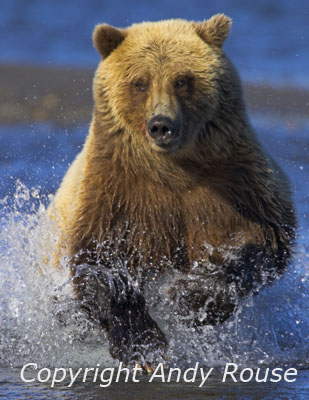
Perhaps the one experience that stays in my mind is when a female Grizzly came up to within 3 metres of me with her three cubs. It was a moment of supreme anxiety and yet supreme trust (on both sides), although I am not sure who was watching who! In truth, there are too many experiences to count. You must remember the reasons that I choose to be a wildlife photographer. I love animals and love spending my time with animals, for me each encounter is special no matter how big or small the animal is. Photography for me is just a way of making money to spend time with animals. What is important is the relationship that I have with my subject and my interaction with it, not the technical specifications of my camera (which seem all too important for many photographers these days).
 Which
wildlife photographer would you name as you teacher or idol?
Which
wildlife photographer would you name as you teacher or idol?
I have never been taught photography by anyone, I have just learnt it myself. I don�t really have any idols but I admire the career of Art Wolfe, as he has redefined how a wildlife photographer should run his business. I also love the work of Vincent Munier from France and my good friend Colin Prior from Scotland.
What takes a great picture, the camera or the photographer?
It is a combination of both, as neither will work without the other. But for a wildlife photographer the most important skill is fieldcraft, such as tracking an animal and predicting its movements. No camera or technical manual can teach you this, which is a reason I think why wildlife photography is the most challenging aspect of all photography. It is also the most rewarding, whether you take a great picture in your garden or in the middle of a forest, the feeling of success is difficult to beat. The problem is that these days the technical elements of photography have come more to everyone�s attention and it is considered that technical knowledge is the key to taking a good image. Whilst some technical knowledge can go a long way, in wildlife photography it is perhaps one of the least important skills. My opinions of course are against a lot of the technical gurus these days and this can lead to some unpleasant emails � one guy recently wrote to me to say that I wasn�t a real photographer because I didn�t use Photoshop, can you believe it!!
 What
is the one thing that a beginner in wildlife photography should
always remember?
What
is the one thing that a beginner in wildlife photography should
always remember?
Like I said earlier, it is a very difficult career these days. My advice to your readers is to enjoy their photography and to forget about becoming professional, it will be very, very difficult no matter how talented you are. Even if you get lucky and become a professional, you will soon realise just how difficult it is to remain a professional and keep earning enough money to eat!
What are your other interests, apart from photography?
To be honest the life of a wildlife photographer does not leave much time for anything else, especially in these days of fast and furious business. What I do is not a job but a life choice, a lifestyle that I lead which dictates that I spend a lot of time away from home. I am a fanatical football and curry fan, and I try to see West Ham after a chicken madras whenever I can.
You can see more of Andy�s work on his website � http://www.andyrouse.co.uk
In the second
part of our interview with Andy Rouse: the secrets of Andy�s
digital workflow.