
Articles: "Wolfgang Tillmans: Artist, Photographer, or neither?"
 I
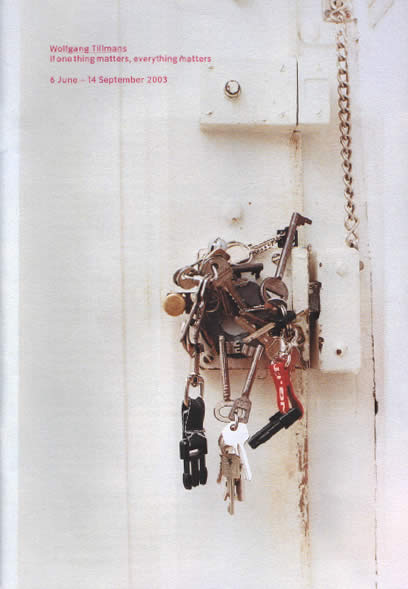
didn't know too much about Wolfgang Tillmans before visiting his latest exhibition, "If
one thing matters, everything matters", at Tate Britain in London.
I know that he was the first ever photographer to win the Turner Prize, in
the year 2000, with some photographs that look very much like abstract paintings.
I know that he's German and that he studied photography at a UK university.
I know that he's a relatively young photographer, in his 20s I think. There
are a lot of photography exhibitions on this summer in London and, after visiting
the excellent Cruel
and Tender exhibition at Tate Modern, I was keen to find out why Tillmans
warranted such a major show at Tate Britain.
I
didn't know too much about Wolfgang Tillmans before visiting his latest exhibition, "If
one thing matters, everything matters", at Tate Britain in London.
I know that he was the first ever photographer to win the Turner Prize, in
the year 2000, with some photographs that look very much like abstract paintings.
I know that he's German and that he studied photography at a UK university.
I know that he's a relatively young photographer, in his 20s I think. There
are a lot of photography exhibitions on this summer in London and, after visiting
the excellent Cruel
and Tender exhibition at Tate Modern, I was keen to find out why Tillmans
warranted such a major show at Tate Britain.
This is how the Tate website summarises the exhibition:
"Turner Prize winner Wolfgang Tillmans is one of the most successful and influential artists working in Britain today. This beautiful exhibition is the first major survey of his work in the UK and includes new work made especially for Tate Britain, along with a range of images and installations from throughout his career."
There are 7 rooms in total, showing a large number of photographs which range from 6x4 inches in size to huge images that go from floor to ceiling. According to the the exhibition catalogue, Tillmans carefully arranges his photographs in related series. The 7 rooms are organised chronologically so that the viewer sees a recreated version of Tillmans' first ever photographic exhibition in room 1, and then his latest work from 2003 in Room 7.
Less than an hour after arriving, my girlfriend and I were back outside the gallery in the bright sunlight of a summer afternoon. That's a pretty quick visit, even by our standards (we usually race around even the most interesting of exhibitions). Both of us were completely unimpressed by what we had seen, and after a few minutes of trying to pinpoint why we were unimpressed, we gave up and hurried home.
Two weeks later, and I think I've figured out why the Tillmans show left me cold (I can't speak for my girlfriend here...). Interestingly I think it opens up a much wider debate about the relationship between photography and art.
Tillmans is referred to above as "one of the most successful and influential artists working in Britain today". The key word here is artist, as opposed to photographer. Tillmans uses photography as a means to an end, just as a sculptor would use stone or a painter would use paint. Photography is the medium; art is the end result.
Where the Tillmans exhibition falls apart, at least in my opinion, is that the quality of the medium undermines the end result. Most of the photographs in the exhibition are 6x4 inch prints, much like you would get back from Boots, Jessops or whichever high-street printing service you use. Nothing wrong with that in itself - it could be an interesting artistic subversion of one of the most popular photographic formats.
The photographs themselves, however, also resemble typical 6x4 inch prints in terms of their quality. The majority of Tillmans' photographs were either badly composed, out of focus, unsharp, poorly exposed, or all of the above. To my photographers eye, after seeing so many excellent images by other photographers during the last few years, Tillmans' images were of a poor standard, looking more like family snaps than expertly-taken photographs.
Furthermore, the subject matter of the photographs closely resembles family snaps. The main impression that I took away from Tillmans' exhibition was that he's a homosexual German man who visits a lot of nightclubs and has a lot of friends. I learnt this because there are a lot of photographs of nightclubs, penises and young German men and women (whom the notes tell me are Tillmans' friends). It seemed to me that Tillmans has somehow managed to forge a lucrative career out of taking snaps of his normal, everyday life.
Now I don't know if Wolfgang Tillmans intended his photographs to be like this; he may be a very competent photographer who's just decided to try and bend the medium to his own use by making his images blurry and commonplace. I didn't come away with that impression though. And I can't help feeling that this lack of photographic competence may have contributed to Tillmans being considered to be an artist, rather than a photographer. Certainly I don't think his work would stand up if he sent it to photography magazines or entered it for photography competitions.
At the end of the day, I could only view most of the photographs in the exhibition as poorly taken snaps, and therefore couldn't even begin to consider Tillmans as an artist, hence the "neither" in the title of this article. This may be as much of a reflection of me as it is of Tillmans. I wouldn't necessarily go to a sculptor's exhibition and criticise it because of the poor standard of sculpting, because I don't know anything about that medium. As a photographer, however, I can judge the standard of work of other photographers for myself, even if they do consider themselves to be artists. I didn't expect all of Tillmans' images to be perfect, but at the same time I didn't expect to be thinking "Why are all these photographs being viewed by all these people?".