
PhotographyBLOG


March 2008 Prize Giveaway


LATEST REVIEWS

Nikon D700
Power Retouche
Sony W300
Panasonic LX3
Canon EOS 1000D
Sony H10
Fujifilm S8100fd
Olympus E-520
Epson R2880
Samsung GX-20

All Reviews
Best Digital Cameras

LATEST COMMENTS

New Sony DSLR on September 10th
Date: Sep 07, 2008
Name: Adrian

Vanessa Winship Wins Sony Photographer of the Year
Date: Sep 07, 2008
Name: CJ Stone

New Canon DSLR Imminent
Date: Sep 07, 2008
Name: Mustafa Ajlan Abudak-Turkey

New Sony DSLR on September 10th
Date: Sep 07, 2008
Name: Mustafa Ajlan Abudak-Turkey

Canon EF-S 18-200mm f/3.5-5.6 IS
Date: Sep 06, 2008
Name: Jack

Pentax Optio E20
Date: Sep 06, 2008
Name: jane coy

Epson Stylus Photo PX800FW
Date: Sep 06, 2008
Name: Ian Samson

Epson Stylus Photo PX800FW
Date: Sep 06, 2008
Name: Ian Samson

Casio Exilim EX-S500 Announced
Date: Sep 06, 2008
Name: JJ

New Sony DSLR on September 10th
Date: Sep 06, 2008
Name: at keith

Latest Threads

MOST COMMENTS

Panasonic DMC-LX1 Announced (789)

Panasonic Lumix DMC-LX2 (478)

Ricoh Caplio R3 Announced (421)

Panasonic DMC-FZ30 Announced (359)

Canon G7 (222)

Fujifilm Finepix E550 Review (211)

Sony DSC-H5 and Sony DSC-H2 (193)

Canon EOS 400D (186)

Samsung S800, Samsung S600 and Samsung S500 (182)

3 Megapixel Nokia N80 Cameraphone Announced (148)


ARCHIVES

September 2008
August 2008
July 2008
June 2008
May 2008
April 2008
March 2008
February 2008
January 2008
December 2007
November 2007
October 2007

Latest News Stories

AFFILIATES

Digital Photography Blog
Digital Wedding Forum
Everyday Eye
Mark Goldstein
Mobile Phones
ShutterPoint
 

How to Neutralize a Digital Camera
How to Neutralize a Digital CameraGeorgia Institute of Technology Press Release

Newswise — Researchers at the Georgia Institute of Technology have completed a prototype device that can block digital-camera function in a given area. Commercial versions of the technology could be used to stymie unwanted use of video or still cameras.

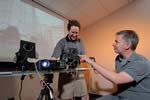
The prototype device, produced by a team in the Interactive and Intelligent Computing division of the Georgia Tech College of Computing (COC), uses off-the-shelf equipment – camera-mounted sensors, lighting equipment, a projector and a computer—to scan for, find and neutralize digital cameras. The system works by looking for the reflectivity and shape of the image-producing sensors used in digital cameras. Gregory Abowd, an associate professor leading the project, says the new camera-neutralizing technology shows commercial promise in two principal fields – protecting limited areas against clandestine photography or stopping video copying in larger areas such as theaters.

“We’re at a point right now where the prototype we have developed could lead to products for markets that have a small, critical area to protect,” Abowd said. “Then we’re also looking to do additional research that could increase the protected area for one of our more interesting clients, the motion picture industry.”

Abowd said the small-area product could prevent espionage photography in government buildings, industrial settings or trade shows. It could also be used in business settings—for instance, to stop amateur photography where shopping-mall-Santa pictures are being taken.

James Clawson, a research technician on Abowd’s prototype team, said preventing movie copying could be a major application for camera-blocking technology.

“Movie piracy is a $3 billion-a-year problem,” Clawson maintains—a problem said to be especially acute in Asia. “If someone videotapes a movie in a theater and then puts it up on the web that night or burns half a million copies to sell on the street – then the movie industry has lost a lot of in-theater revenue.”

Moreover, movie theaters are likely to be a good setting for camera-blocking technology, said Jay Summet, a research assistant who is also working on the prototype. A camera’s image sensor—called a CCD—is retroreflective, which means it sends light back directly to its origin rather than scattering it. Retroreflections would probably make it relatively easy to detect and identify video cameras in a darkened theater.

The current prototype uses visible light and two cameras to find CCDs, but a future commercial system might use invisible infrared lasers and photo-detecting transistors to scan for contraband cameras. Once such a system found a suspicious spot, it would feed information on the reflection’s properties to a computer for a determination.

“The biggest problem is making sure we don’t get false positives from, say, a large shiny earring,” said Summet. “We need to make our system work well enough so that it can find a dot, then test to see if it’s reflective, then see if it’s retroreflective, and then test to see if it’s the right shape.”

Once a scanning laser and photodetector located a video camera, the system would flash a thin beam of visible white light directly at the CCD. This beam – possibly a laser in a commercial version – would overwhelm the target camera with light, rendering recorded video unusable. Researchers say that energy levels used to neutralize cameras would be low enough to preclude any health risks to the operator.

Still camera neutralization in small areas also shows near-term commercial promise, Abowd said. Despite ambient light levels far higher than in a theater, still cameras at a trade show or a mall should be fairly easy to detect, he said. That’s because image sensors in most cell phones and digital cameras are placed close to the lens, making them easier to spot than the deeper-set sensors of video cameras.

Camera neutralization’s potential has helped bring it under the wing of VentureLab, a Georgia Tech group that assists fledgling companies through the critical feasibility and first-funding phases. Operating under the name DominINC, Abowd’s company has already received a Phase 1 grant from the Georgia Research Alliance (GRA) with VentureLab assistance.

Abowd said that funding availability will likely decide which technology—small- or large-area—will be developed first. DominINC will apply soon for GRA Phase 2 money, Abowd said. Those funds would be used to aid anti-piracy product development, as would any funding coming from the film industry.

Other potential funding, from industry and elsewhere, would likely be used to develop anti-espionage small-area applications.

Stephen Fleming, Georgia Tech’s chief commercialization officer, said motion-picture groups are actively looking for technology to foil piracy. Movie distributors might even promote camera-neutralizing systems by refusing to send films to theaters that don’t install anti-piracy systems.

There are some caveats, according to Summet. Current camera-neutralizing technology may never work against single-lens-reflex cameras, which use a folding-mirror viewing system that effectively masks its CCD except when a photo is actually being taken. Moreover, anti-digital techniques don’t work on conventional film cameras because they have no image sensor.

Good computer analysis will be the heart of effective camera blocking, Summet believes.

“Most of the major work that we have left involves algorithmic development,” he said. “False positives will eliminated by making a system with fast, efficient computing.”

Also involved in the camera-neutralizing project are Shwetak Patel, a College of Computing PhD student; Khai Truong, a former Georgia Tech PhD student who is now at the University of Toronto, and Kent Lyons, a College of Computing post-doctoral student. A paper on this technology was published and presented at the Ubicomp 2005 conference in Tokyo, Japan, last September.

Published: Monday, June 19, 2006

Compare Prices

Support PhotographyBLOG: Buy this product from one of our affiliate retailers (US first/red, UK second/blue):


Reader Comments

  1. This is very interesting and an incredible advance in technology, but I sometimes wonder why people bother to announce these innovations.

    By letting all and sundry know about it gives everyone a head start. If I was paparrazzi, I would now just go and buy a good old-fashioned film SLR and stock up with film for the future.

    It also gives other boffins (on the dark side) a chance to work out a sufficient "antidote" which could be attached to a digital camera to prevent this from happening.

    Should have kept it in the dark and just watched in glee as the Paps all floundered during an important event.

    I guess its human nature to want to show of how clever we are!

    Good stuff!

    Nick Stubbs at 02:40pm on Monday, June 19, 2006

  2. Sounds like it's time for the filter makers to put the mirrored-see-through-anti-neutralizer-protector (MSTANP)on the market. Bounce that beam back and create havoc! Maybe even a beam-amplifier that will cause a small "Poof"!

    nick in japan at 09:34pm on Monday, June 19, 2006

  3. A digital camera neutralizer neutralizer (DCNN) as it were ... brilliant !

    Nick, it is getting down to the wire on my camera purchasing decision.
    If it weren't for the fact that we gave the G3 back to my father I'd get
    my wife a new cell phone for our anniversary.

    I think I've decided on the V610 over the TZ1, if for nothing else, just
    because of its smaller size. I suppose the 3.0 Mbs Bluetooth will come
    in handy for small transfers. Its in-camera image processing is also a
    nice touch. If it had OIS, it would be a slam dunk.

    GARY POGODA at 06:57am on Tuesday, June 20, 2006

  4. Gary, you know my feelings on the basic requirement of 28mm. There are alot of happy folks out there that shoot with a non-zoom, fast, prime lens and do their zooming with software with a high quality image.
    The really nice thing about a wide lens is that "IS" really isnt a factor as much.
    With that in mind, the lists you compile of "Needs" and "Wants" become blurrier.
    I mentioned somewhere recently that cell phones with cameras are the rage over here, I'm not into cell phones, nobody to call, so I can't talk about them, but, seems like they are another viable alternative.
    If things REALLY get bad, contact me and we will discuss the LX-1 option.

    nick in japan at 08:16am on Tuesday, June 20, 2006

  5. So, if you had to choose between a V610 and TZ1, you would choose
    a TZ1 because of its 35mm wide end vs. the V610's 38mm wide end?

    GARY POGODA at 05:58pm on Wednesday, June 21, 2006

  6. The difference between 35 and 38 cannot be measured! Some folks really dont care about the difference that a 28mm lens makes until they view the comparison images that abound. Your research has narrowed your choice for your wife to these 2 cameras, I feel I'm intruding into your personal life, or, maybe, someone to blame when your wife says "Holy Shirt, this camera doesn't take wide pictures at all!!"
    I got my wife that Pentax S6, ONLY because she didn't care about being wide or not, just for it's small size and other capabilities, got a deal on it too!
    Personally, I will never buy another pocket camera unless it is at least 28mm!
    I'm VERY suprised that Kodak hasn't upgraded the V570, wide angle, yet. I think you will see one soon.
    Panasonic's new L1 is going to be intoduced soon with a VERY attractive lens, alot of planning and thought went into exactly what the lens capabilities would be, best suited to the semi-pro target folks, yep, it starts out at 28mm!!! Wow! Perfect. I guess those folks have similar thoughts on "needs" as I do.

    nick in japan at 09:47pm on Wednesday, June 21, 2006

  7. ..and, maybe a cell phone with camera is a good choice for now. Later this summer another 500 or so new cameras will be introduced, maybe the perfect one for your better-half!

    nick in japan at 09:50pm on Wednesday, June 21, 2006

  8. So you're saying I should go with the V610 over the TZ1. smile

    My wife has had a cell phone camera for the past two years, and she's
    never used it once. Not even when her Casio died, and she didn't have
    any camera (that was before we borrowed the G3). She even went out
    and bought disposable film cameras rather than use her cell phone.

    A 28mm wide lens is a nice FEATURE, but it is too late for FEATURES. I
    need a CAMERA, and I need it SOON !!!

    GARY POGODA at 09:24am on Thursday, June 22, 2006

  9. Gary, I am honored that you have taken time to ask me to help you with a very serious decision in your life. I have exhausted my suggestions. You have alot more grey matter than I, able to possibly quote all the noise statistics and capabilities of all current models, I can't. I don't know you or your wife personally, couldn't pick you out of , even, a line-up, but from our conversations I have concluded that your needs and wants differ from mine, 28mm isn't just a feature to me it's a necessary requirement. I think you would best WAIT to get a camera because it's obvious that you are not convinced that anything out there right now is adequate! IMHO!

    nick in japan at 11:19am on Thursday, June 22, 2006

  10. Thanks, Nick. I think I will take your advice and go with the V610. smile

    BTW, you are absolutely right about my not being convinced, but this
    is not a "very serious decision". It's actually a laughing matter since I
    am about to ignore all the "good" advice I have given others, namely:

    1. Don't buy a camera with a 1/2.5" CCD.
    2. Don't buy a camera with high image noise.
    3. Don't buy a high-zoom camera without OIS.

    GARY POGODA at 11:46am on Thursday, June 22, 2006

  11. That new Casio 1000 sure looks good, big sensor and 28mm too, along with IS!

    nick in japan at 12:15pm on Thursday, June 22, 2006

  12. OOPS! NOT 28mm, "Never mind"!

    nick in japan at 12:33pm on Thursday, June 22, 2006

Add Your Comments

Please keep your comments relevant to this article. All spam postings will be removed. To create a live link, simply type the URL (including http://) or email address. You can include up to 2 URLs. Please use TinyURL or a similar service for longer URLs. Line breaks and paragraphs are automatically converted - you don't need to use <p> or <br> tags.

Name (required):

Email (required, not displayed):

Website (optional):

Enter your comments:

Remember me

Email me when someone replies to this comment

Enter the word you see below:


Pixmania Logo

Discover a wide range of digital cameras at low prices. Buy cheap cameras from Sony and Canon. Share your photos thanks to digital photo frames.


© Copyright 2003-2008 Photo 360 Limited
Best Viewed at 1024x768 Screen Resolution