« Back to news

Sony DSLR-A100

Mark Goldstein | Digital SLR Cameras | June 6, 2006 | 25 Comments |

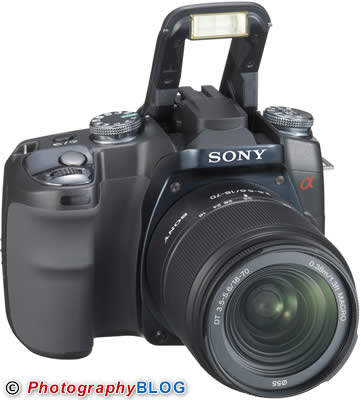
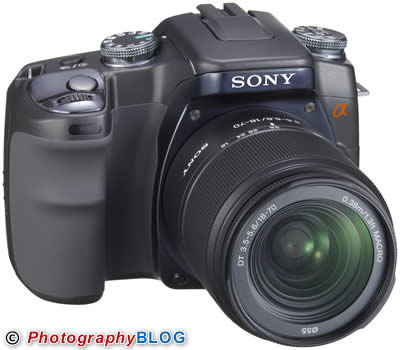
Sony DSLR-A100The Sony DSLR-A100 is announced. Despite several websites leaking the news ahead of schedule (including Sony themselves), Sony has now unveiled the 10.2 megapixel Sony A100 DSLR and a wide range of lenses and accessories to go with it. With built-in image stabilisation and dust-removale features, the new Sony A100 certainly looks like it has what it takes to challenge the likes of Canon and Nikon in the mid-range DSLR market, proving that it is more than simpy a re-badged Konica Minolta. With a price-tag of $900 body-only and $1000 for the body and 18-70mm kit lens, the Sony A100 is also competitively priced.

Sony Press Release

SAN DIEGO, June 5, 2006 — Sony is jumping into the digital single lens reflex (D-SLR) camera market with today’s introduction of the a (alpha) DSLR-A100 system. The system combines advanced SLR features with other Sony digital imaging innovations. With its 10.2-megapixel APS CCD image sensor, the DSLR-A100 camera is expected to have the highest resolution available in its class. It will be introduced with 19 high-quality Sony lenses, and will be compatible with most of the former Konica-Minolta Maxxum® mount lenses. The system will include a wide range of accessories as well. Sony developed a new Dynamic Range Optimizer image analysis technology to provide exceptional picture quality and natural color reproduction, along with a new Bionz image processing engine. This new engine supports a continuous burst mode for fast-action shooting and performs intelligent power management.

“Our system will be attractive to people who are ready for something beyond what’s available in D-SLR cameras today,” said James Neal, director of marketing for digital imaging products at Sony Electronics. “Sony enthusiasts who want to upgrade from point-and-shoot cameras, as well as former Konica-Minolta digital and film SLR camera users who have already made substantial investments in lenses, will welcome this initiative.”

Fight Blur With Your Camera, Not Your Lens
The DSLR-A100 camera is engineered to combat blurry pictures through high light sensitivity (up to ISO 1600) and Super SteadyShot® image stabilization, a Sony technology that shifts the image sensor to compensate for camera movement.

Because Super SteadyShot is built into the camera body, all compatible telephoto, wide-angle, standard and macro lenses are automatically image-stabilized. This also allows from two to 3-1/2 stops of latitude in exposure, which supports hand-held shooting at longer shutter speeds than would otherwise be possible. In the end, you have more opportunities to shoot in natural lighting without a tripod or a flash.

Innovative Approach to Deliver Exceptional Image Quality
The a (alpha) DSLR-A100 will be the only D-SLR camera that can optimize dynamic range, meaning the range from highlights to shadows, including gain and contrast, through in-camera hardware processing.

Sony’s Dynamic Range Optimizer (DRO) analyzes the captured image data and instantly determines the best exposure and color tonality of an image before JPEG compression. Unlike software optimization of a processed image, DRO is performed in the hardware. It is the first hardware-based DRO solution with the speed required for high-speed shooting.

Now You Can Really Catch The Action
The high-speed Bionz image processing engine allows you to capture pictures at lightning speed. The camera will offer high-speed burst shooting at up to three frames per second continuously, at 10.2-megapixels and the finest JPEG compression. For those action shots, you’re limited only by the speed of your media card.

The new camera will also have a long battery life. The supplied lithium ion battery gives you up to 750 shots per full charge, depending on usage patterns and environmental conditions.

Get Dust under Control
“For D-SLR camera users,” Neal said that, “dust is the enemy.”

Dust collects on the image sensor, usually when lenses are changed, and appears as annoying spots in photos, which then need to be retouched later. Sony’s new system offers a novel, two-pronged approach to fighting dust.

The camera’s CCD image sensor has an indium tin oxide coating to avoid static build-up so that dust does not readily adhere. Additionally, when you turn the camera on or off, an anti-dust feature is activated to literally shake off dust particles.

A Flexible System for Creative Possibilities
Sony is continuing its long-standing relationship with Carl Zeiss® to deliver superior optical performance for the a (alpha) camera system. The two companies have co-developed three lenses, including an ultra-wide, 16-80 mm Vario-Sonnar T* zoom model and two fixed focal length telephoto models ─ a Planar T* 85 mm and Sonnar T* 135 mm.

The system will also be supported with a full range of accessories, including a line-up of flashes, cable releases, rechargeable battery packs and several styles of carrying cases.

Convenience and Simplicity
The a (alpha) camera also features eye-start auto focus, which starts focusing your picture before you even press the shutter; a 2.5-inch Clear Photo LCD Plus™ screen for wide-angle viewing and exceptional color reproduction; JPEG and RAW file format support; and a comfortable camera grip with easily-accessible function and mode dials.

There is a slot for CompactFlash Type I/II and Microdrive® media cards. The camera also accepts Memory Stick PRO™ and Memory Stick PRO Duo™ media cards through a supplied adaptor.

The DSLR-A100 camera body will be available for about $900. The DSLR-A100K kit, which includes the camera body along with an 18-70mm zoom lens, will be available for about $1,000. Both ship in July and will be available at SonyStyle.com, Sony Style retail stores (http://www.sonystyle.com/retail), and authorized dealers nationwide. Pre-orders begin online today at http://www.sonystyle.com/dslr.

Full-service product support for the a (alpha) DSLR-A100 system will be available at http://esupport.sony.com. Sony is also offering service to former Konica-Minolta customers. More service information is available at http://www.esupport.sony.com/EN/KM/service.html.

For online support, such as drivers and other documents, former Konica-Minolta users can also visit http://ca.konicaminolta.com/support/index.html.

Sony Alpha Lenses Overview
Sony Alpha Accessories Overview
Sony DSLR-A100

Sony DSLR-A100


Share, bookmark or email this review

If you enjoyed this article, please spread the word by bookmarking or promoting it on social sites, post it on Facebook, or email it to a friend!

Your Comments

25 Comments so far | Post a comment

#1 nick in japan

Minolta owners rejoice! Too bad I dont have much in the way of Minolta AF lenses in my collection! I missed the statement about a live preview, was there one?
Gonna need an exceptional sensor review to get me to buy one of these... Naw, gonna need alot more than that!

10:41 am - Tuesday, June 6, 2006

#2 Nicholas

I am an R-1 owner/user.

The Alpha disappoints in two vital areas:

No flash PC connection, Flash sync at 1/125.

It is a noisy ( hardware ) camera as reported by Imaging- Resource.

My R-1 is silent, syncs to 1/2000.

My perspective is as a people photographer.

These issues for me are a deal killer.

I will wait for the PRO Alpha, and with that 24-105 equiv Zeiss lens, I would have an upgraded R-1.

Regards, Nicholas

10:47 am - Tuesday, June 6, 2006

#3 Zoltan

Sensor review? Nick, I think it's pretty safe to assume this camera uses the same CCD as the Nikon D200, so just download some full-resolution D200 samples, print them at 300ppi and see if they meet your expectations

12:02 pm - Tuesday, June 6, 2006

#4 mediyoga

I just bought my canon 30 D ! Did I make a mistake?!!
Krishna Raman

12:33 pm - Tuesday, June 6, 2006

#5 Nicholas

To Zoltan,

Do you think Nikon would enter into a business supply arrangemennt with Sony, where Sony could use the delivered products
( sensor ) against Nikon.

I don't think Nikon is that naive in business.

All this means the Alpha A100 sensor will have to fal far short of the image quality of Nikon's version.

All IMHO.

Regards, Nicholas

2:06 pm - Tuesday, June 6, 2006

#6 Zoltan

To mediyoga: it depends on the type of photography you do. If you bought the 30D because you shoot fast action most of the time, then you obviously haven't made a mistake, as the frame rate of your 30D is definitely higher than that of the A100. And generally speaking, if you are satisfied with the handling, performance and output of your new camera, then again, who could accuse you of having made a mistake? BUT if you often change lenses in a dusty environment and find dust specks on a lot of your photographs as a result, then a DSLR with a sensor dust buster (an Olympus or the new Panasonic or this new Sony) might have been a better choice.

To Nicholas: it is all a matter of how much Nikon were prepared to pay for the exclusivity of the use of Sony's sensor. The sensor is just one of the components of a camera and competing manufacturers might use one or more shared components witout ceasing to compete with one another. In the past, Nikon have been using Sony sensors that other camera makers, including in some cases Sony themselves, used in their competing models too. It would not be the first case.

3:17 pm - Tuesday, June 6, 2006

#7 nick in japan

I think I was left with the impression that the sensor "may" or "appears to be" a Nikon D200 product, even so, I also remember that Nikon had a problem in this subject area. I hope Sony didn't buy up all the defective sensors( if that was the problem) The sensor combined with the processing engine will produce an image that may, or, may not be the same. Sony likes to experiment, ie, the 4 color sensor that flopped, no telling what kind of "beta' combo the camera will produce, that's why reviews of sensor performance are a smart thing to look , not just initial super-hype that preceeds every new camera.

9:38 pm - Tuesday, June 6, 2006

#8 AA

Nicholas -

Sony and Nikon have had a parts/supply relationship long before you were even allowed to obtain certain industry information thanks to the Internet over the recent years.

I used to own a Nikon 8mm Video camera back in the early 90's. It was a re-badged Sony video camera, except that it had a Nikon lens on it (supposedly). Otherwise, there was no doubt that the video camera was a Sony. Everything was the same except for the label and the lens.

No, they are not naÏve as you would say - these giant corporations have been doing the parts/supplier thing because that's just smart business. You may be confused as a consumer because you've got that Bling-Bling mentality locked in to your head, but that's just the way it is.
I don't understand why people make such a big deal out of such parts/supplier situations - look at the various parts that are supplid by all the different manufacturers that go into anything you own! For example, when I open up the hood of my Nissan, I see loads of electronic and computer components made by Hitachi.

The sensor in the A100 is the exact same CCD one as the one in the D200. I was hoping that it was going to be CMOS, but hey, it's a Sony. In fact, I am glad that it is. Now we'll just be seeing more of the sensors' photos - which can't be a bad thing, to have so many of us test it out and mess with it.

11:37 pm - Tuesday, June 6, 2006

#9 lutz

If Anti-Shake is really improved as they state - this would be a huge advantage

3:08 am - Wednesday, June 7, 2006

#10 nick in japan

This camera appears to be something to consider for folks that are starting out with digital, and, those that have access to Minolta lenses. Not enough to sway the Nikon and Canon users tho. Live preview sure would be nice, I get real tired of checking the screen for the EV adjustments during a shoot!

3:31 am - Wednesday, June 7, 2006

#11 Rick Evertsz

To Nicholas,

Given that it's using the Minolta flash system, I presume it has HSS when used with either of the two Sony flashes (re-badged Minolta ones). That means it syncs at ANY shutter speed, but with reduced power. Sometimes the loss of power is a drawback of course smile

I have a KM5D with 3600 flash. Most of the time, I'm close to the subject when I want to use a high sync speed in daylight. Suits me, but it may not suit your usage, of course.

6:22 am - Wednesday, June 7, 2006

#12 Nichoas

This is the best thread that I have participated in a long time.

Good opinions, debate, info.

( I did say Nikon is NOT naive ).

One thing for sure:

We won't have long to wait for the formal reviews.

Regards, Nicholas

P.S. Thank you Sony

11:06 am - Wednesday, June 7, 2006

#13 Mike Stokes

I have been a photographer man and boy having just bought my first digital camera 2 years ago a Minolta a2 Digicam which I have photographed My first Digital weddings
which was a real nightmare having been used to the exposure latitude 120 film and 400asa The minolta did have some advantages ie antishake 1/15th sec hand hold at 100asa inside the church. This is just a back up camera now as I,ve just sold all my medium format cameras and bought a canon 20d 6 months ago which takes great pics but I'm already looking forward to the Sony a200? release This camera for me to upgrade from the 20d would need the following spec... everything the a100 has plus flash sync at 1/250 plus pc socket and same sensor as Nikon dx2

1:47 pm - Thursday, June 15, 2006

#14 Mauro Zeltzer

To Lutz :
I own a Minolta Maxxum 5D , from wich I will keep the lenses when moving to to the Alpha A100, and I do love the I S . I have gittery hands and that system help me a lot. Hope Sony will not tamper with it.

12:48 am - Saturday, June 17, 2006

#15 nick in japan

The more I look at the images taken with a 5D, the more I think that the improvements that Sony will do, will make this system a REAL winner! What impresses me alot is the higher ASA use!
Please look at the following site to confirm my suspicions!
http://www.gustavjensen.com/blog/

5:49 am - Saturday, June 17, 2006

#16 Gil Knutson

I fear the colour quality of the A100 will not be that of the 5D or 7D. That special quality that many notice with Minolta cameras appears to be gone. It is more "Sony like". Some may be happy, many, like myself, feel it is a loss. It would be nice to be able to choose either Sony colour or KM-Minolta colour. Perhaps Sony could include that in an upgrade of the software. They already have a number of choices, such as flourescent, bright sun, etc., so that would be a brain-deader. smile)

Gil
Sardis, BC

4:28 pm - Sunday, June 18, 2006

#17 nick in japan

Gil, thanks for confirming my suspicions that there is something special about that Minolta color. With the sensor being Nikon, and the processing being, well, who REALLY knows, the final image could be just about anything. I think we become attracted to the subtle differences a camera/ sensor produces and really feel a loss when we are without. I have viewed those images at the site mentioned above, and I realized that there was, indeed , something special about them.

9:35 pm - Sunday, June 18, 2006

#18 Zoltan

Nick,

Erm, what do you mean by "the sensor being Nikon"? I thought it has already been discussed that Nikon has been using Sony sensors for quite some time.

BTW there are now LOTS of sample pics on the Web so one can start to form an idea what the colour rendition of the A100 is like.

9:29 am - Monday, June 19, 2006

#19 nick in japan

Sorry about that mis-use of" Nikon "! I was thinking about the problems that have worried some folks with the D200, and my train of thought was along those lines.
I never did hear about problems with the sensor being resolved, evidently they have, if it is , indeed, the same sensor produced for the D200... or not??

11:18 am - Monday, June 19, 2006

#20 Peter Rivard

The Zeiss lenses are already up for (pre-) order on Japanese online outlets, to be shipped in October. The 16-80 zoom is on sale for just under US$800, the 135 f/1.8 is about $1600, and the 85 f/1.4 for a bit over $1400. Sometimes prices in Japan are 40% higher than in the States, sometimes about the same, so it's hard to say what this will mean for eventual US prices. However, the a100 body itself is on offer for about US$850, a bit less than the suggested US price, so maybe the lenses won't be any cheaper in the states, either.

3:44 pm - Saturday, June 24, 2006

#21 nick in japan

Pete, I pray every night the yen will return to 275/$, well, maybe 130 will do just fine!

2:28 am - Sunday, June 25, 2006

#22 barry wood

nikon are stuck with the film heritage and oneday will go the way minolta bronica etc have gone sony have a nack at quality and value and I have no doubts they will blow nikon away its going to be a two horse race canon sony just like the video market

9:33 pm - Thursday, July 13, 2006

#23 Ted

Does this mean Sony's "new" APC sized CCD is far better with R1's CMOS sonsor? Did I miss something? I'm happy with R1 though too slow to capture stolen/very important moments.

Feedback pls.
Thanks much

8:05 pm - Friday, July 14, 2006

#24 lutz

most likley it means only that the A100 CCD is cheaper to produce (synergies with the production for other manufacturers?) than the high-end CMOS fromthe R1

8:15 pm - Friday, July 14, 2006

#25 Fred

As a Minolta 5D owner I thought the Sony A100 would be like having a few extra horsepower under the bonnet. Not so! I found that the noise at ISO400 was far worse than my 5D and when the ISO control was set to Auto, the camera frequently reverted to ISO 400 because of the lighting conditions. As I normally shoot at a constant ISO400 the Sony A100 would actually give me worse quality. Needless to say I returned the camera and I will stick with my 5D until such time that a low noise 10 megapixel camera with antishake becomes available.

6:09 am - Tuesday, August 8, 2006

Post a comment

Please enter the word in the image below:


Pixmania Logo

Discover a wide range of digital cameras at low prices. Buy cheap cameras from Sony and Canon. Share your photos thanks to digital photo frames.