
Tamron 18-270mm Lens for Nikon
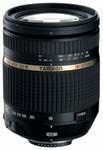 The Tamron AF18-270mm F/3.5-6.3 Di II VC is a new 15x zoom lens for Nikon DSLR cameras with built-in motors. Providing a focal length equivalent to 28-419mm, the Tamron 18-270mm lens is also equipped with a highly effective Vibration Compensation (VC) mechanism. Note that this lens is designed for exclusive use on digital SLR cameras equipped with smaller sized (APS-C sized) image sensors. The new Tamron 18-270mm lens for Nikon digital SLRs with built-in motors will be available in Japan from September 20th 2008.
Tamron Press Release
ANNOUNCING THE TAMRON AF18-270MM Di II VC ULTRA HIGH POWER ZOOM LENS
A Technological Breakthrough-World’s Longest Range 15X Zoom Lens Has Exclusive Built-In Vibration Compensation Mechanism Optimized For Consumer Digital SLR Cameras
September 1, 2008, Saitama City, Japan - Tamron Co., Ltd., under the leadership of Mr. Morio Ono, President, has unveiled a unique ultra high power zoom lens-the Tamron AF18-270mm F/3.5-6.3 Di II VC LD Aspherical (IF) MACRO (Model B003), the first digital SLR lens in the world that delivers a remarkable zoom ratio of 15X (28-419mm equivalent) and is equipped with a highly effective Vibration Compensation (VC) mechanism. Designed exclusively for digital SLR cameras with APS-C sized image sensors, the new lens delivers outstanding image quality over its entire zoom range and its exclusive VC anti-shake system facilitates sharp handheld photography even at the longest telephoto settings.
Product Name Date of Launch (in Japan)
AF18-270mm F/3.5-6.3 Di II VC (Model B003)
For Canon and Nikon with Built-In Motor September 20, 2008
With its vast zoom-range, the Tamron AF18-270mm F/3.5-6.3 Di II VC lens enables the user to cover virtually any photographic subject from wide angle to ultra telephoto simply by turning the zoom control. It covers angles of view equivalent to 28mm to 419mm when converted to the 35mm format. In addition, this breakthrough lens is equipped with Tamron’s exclusive, proprietary tri-axial Vibration Compensation (VC) mechanism that eliminates or substantially reduces the effects of handheld camera shake. As a result, the user can enjoy the convenience of handheld photography in virtually any situation, from shooting candid images, to covering sporting events, to news photography, without worrying about camera shake having an adverse effect on image quality. The new lens will be made available in Canon and Nikon mounts. The price and launch date of the new lens will be announced at a later date.
* 1 “The world’s longest zoom range” and “world’s first” are statements that apply to interchangeable lens exclusively designed for digital SLR cameras equipped with APS-C sized image sensors, as of June 2008, according to Tamron’s survey.
* 2 Tamron’s conversion value is 1.55X
Note: Di (Digitally integrated) II lenses employ optical systems designed for exclusive use on digital SLR cameras equipped with smaller sized (APS-C sized) image sensors. Di II lenses are not designed for use with 35mm film cameras or digital SLR cameras with image sensors larger than 24mm x 16mm. (This special note “APS-C sized image sensors” is hereinafter omitted.)
DEVELOPMENT BACKGROUND
Since launching the Tamron AF28-200mm F/3.8-5.6 (Model 71D) in 1992 that was highly acclaimed as the first high power zoom lens suitable for practical use, Tamron has continued to develop innovative zoom lenses as the “pioneer in high power zoom lenses”. With the AF18-200mm F/3.5-6.3 XI Di II (Model A14), Tamron realized an 11.1X zoom power for the first time in a zoom lens exclusively designed for digital SLR cameras and expanded the telephoto range further to 13.9X with the AF18-250mm F/3.5-6.3 Di II (Model A18), making steady progress in extending the range of high performance, high power zoom lenses.
Tamron’s engineers faced the even more formidable challenge of finding solutions for the problem of “handheld camera shake” while expanding the telephoto range even further and have eventually developed the AF18-270mm F/3.5-6.3 Di II VC. This lens has attained the maximum zoom power of 15X for the first time in the world, namely as a zoom lens exclusively designed for digital SLR cameras. It enables the user to cover an extremely wide angle-of-view range equivalent to a 28mm-419mm lens in the 35mm format. In addition, the lens is equipped with Tamron’s original and exclusive VC mechanism that effectively compensates for “handheld shake”, which would otherwise become visible as un-sharpness or blur in images shot handheld. Moreover this system is effective over the extremely wide focal length range of this extended ultra telephoto lens and Tamron’s VC mechanism provides maximum compensation performance at all focal lengths. The VC system enables the user to enjoy the full benefits of ultra-tele photography comfortably and provides amazingly stabilized viewfinder images as well. In short, this unique VC image stabilization system delivers the maximum potential built into the world’s longest-ratio zoom lens-15X.
Tamron was able achieve all these remarkable accomplishments thanks to its advanced optical / mechanical design technologies and production know-how accumulated over 16 years as the pioneer in high power zoom lens design, and its commitment to ongoing research and development. Even more important, in combining an amazingly high zoom ratio along with the VC function Tamron has maintained a high priority on its traditional goals of lightness and compactness. As a result the new Tamron AF18-270mm Di II VC delivers all the functionality and performance you expect from the latest Tamron ultra high power zoom, a lens that exemplifies our time-honored concept of “One great lens covering everything from wide angle to telephoto”.
MAIN FEATURES
1. World’s first and greatest zoom ratio of 15X, covering 28-419mm 35mm-equivalent angle of view
Going back to the basic concept of “one lens covering everything from wide angle to telephoto,” engineers at Tamron took up the difficult task of expanding the zoom range of Tamron’s high power zoom lenses even further. Their unstinting efforts to extend the telephoto end beyond previous limits while retaining the wide-angle end at 18mm has borne fruit as an ultra high power zoom lens that is exclusively designed for DSLR cameras and boasts the greatest zoom range of 15X for the first time in the world.
2. Tamron’s original VC mechanism for effective shake-free hand-held photography
Tamron’s proprietary VC (Vibration Compensation) mechanism was built in the AF28-300mm F/3.5-6.3 Di VC (Model A20) for the first time. It demonstrated its powerful compensation effect employing a tri-axial system that is designed to let three coils drive a compensator lens electromagnetically via three steel balls. Since the compensator lens is supported on rolling steel balls with very low friction, follow-up performance is also enhanced, resulting in stabilized viewfinder images. Since the mechanism is designed to allow parallel shifting of the compensator lens solely by means of electrical control, the mechanical construction is simpler and more compact, so the lens can be kept as a small and light as possible.
3. Designing a high power, compact zoom lens with VC mechanism: Optical design optimization meets optimum power distribution
In developing the long-range zoom lens, Tamron’s optical designers pursued the optimum distribution of power within the overall optical system based on the optical design know-how Tamron accumulated over 16 years since the introduction of the first compact AF28-200mm in 1992. The resulting optical system uses three hybrid aspherical elements, two LD (Low Dispersion) glass elements and an AD (Abnormal Dispersion) glass element in order to effectively compensate for various aberrations including astigmatism and chromatic aberration, yet this design allows the first optical group to be small enough in diameter to realize the overall goal of a compact lens that incorporates a handheld-shake compensation mechanism.
? Note: In order to realize the high zoom ratio of 15X, the optical system does not use any XR (extra dispersion glass) element. Instead, compactness is achieved through optimization of the power distribution within the whole optical system.
4. Minimum focusing distance of 0.49m over the entire zoom range for the maximum magnification ratio of 1:3.5
The AF18-270mm Di II VC allows close focusing down to 0.49m (20 inches) from the subject over the entire zoom range even though it incorporates the VC mechanism. The maximum magnification ratio of 1:3.5 at its 270mm telephoto end is the top class capability among high power zoom lenses exclusively designed for digital SLR cameras.
* 3 A format covered by an APS-C sized image sensor is smaller than that of 35mm format film. Therefore, this lens is capable of filling the frame by capturing an area that is almost the same as an area covered by a lens designed for the 35mm format and providing the maximum magnification ratio of 1:2.3.
5. Optical system optimized for digital SLR cameras by taking incident rays of light reaching the image sensor into consideration
In order to effectively compensate for changes in aberrations due to zooming, the zoom lens employs an innovative optical system that is designed to converge the angles of rays of light entering from the center to the periphery of the lens. The light rays thus reach the image sensor within a defined circle that assures high imaging performance and reduces light falloff.
6. High resolution performance
As a lens exclusively designed for digital SLR cameras, this zoom lens delivers high resolution and contrast performance for outstanding image quality with sufficient flatness of the field under an extremely wide range of photographic conditions.
7. Thorough countermeasures, including advanced internal surface coatings, prevent ghosting and flare
Tamron employs multi-layer coatings in order to reduce reflections on lens surfaces as well as internal surface coatings (coatings on the cemented surfaces of lens elements) in order to minimize reflections from the sensor itself within the mirror box, a problem inherent to all digital SLR cameras.
8. The world’s first and greatest zoom power of 15X plus built-in VC mechanism achieved along with a remarkably slim maximum diameter of less than 80mm
Designing a lens with the world’s first and greatest zoom ratio of 15X inevitably entailed a larger travel distance of the components within the optical systems, but Tamron has successfully accommodated the optical system as well as the special VC mechanism in a remarkably compact and slim package by employing mechanical design technology accumulated over many years. The result: A slim design measuring less than 80mm in diameter despite the fact that it is an ultra high power zoom lens that incorporates a VC mechanism. Production engineering this unique zoom lens meant incorporating complex optical / mechanical components, and Tamron’s engineers had to employ innovative manufacturing techniques including methods of further enhancing accuracy, reducing weight, and increasing the strength of many components.
? Note: : In order to achieve the world’s first and greatest zoom ratio of 15X, metal mounts are used in both Canon- and Nikon-mount lenses.
9. Zoom lock mechanism for convenience in carrying the outfit
The lens has a built-in zoom lock mechanism to prevent its barrel from sliding forward when the lens is being carried on the camera.
10. Flower-shaped lens hood as a standard accessory
The lens is supplied with a flower-shaped lens hood as a standard accessory. It is designed to efficiently cut harmful light entering at angles other than intended angles at all four corners of the frame. This ensures clear, flare-free images.
11. New outer design matches the newest generation high power zoom lens in the digital era
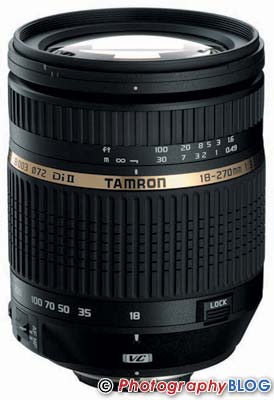
1. The lens employs a new outer design that is more refined and smoother in its overall contours by minimizing concavity, convexity, and variations in profile in order to match the latest digital SLR cameras.
2. A gold-colored metal ring is placed at a key portion of the lens as used in other Di II lenses. The “TAMRON” logo placed in the center portion of the lens enhances visibility of the brand while refining the overall design.
3. Delicate matte finish is added to the black painting over the lens barrel in order to enhance the high quality appearance of the lens.
4. The textured rubber pattern of the zoom and focus control rings has been improved again to a more pronounced, easy to grasp design than the conventional rubber pattern, for better feel and touch in manipulating the lens.
SPECIFICATIONS
Model Name Model B003
Focal Length 18-270mm
Maximum Aperture F/3.5-6.3
Angle of View 75°33’-5°55’ (equivalent angles of view when converted to 35mm)
Lens Construction 18 elements in 13 groups
Minimum Focus Distance 0.49m (over the entire zoom range
Maximum Mag. Ratio 1 : 3.5 (at f=270mm and 0.49m MFD)
Filter Diameter 72mm
Overall Length 101.0mm
Maximum Diameter 79.6mm
Weight 550g*
Diaphragm Blades 7 blades
Minimum Aperture F/22
Standard Accessory Flower-shaped lens hood
Compatible Mount For Canon and Nikon
* The values given are the lens for Nikon.
* The cosmetic design, specifications and performance are subject to change without notice.
Loading comments…