
Canon Digital IXUS 950 IS Review
(also known as the Canon SD850 IS)
Review Date: August 16th 2007
Author: Gavin Stoker
Leave a comment about this Review
|
Introduction
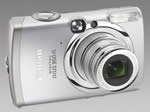
The Canon Digital IXUS 950 IS is an 8 megapixel digital camera with a 2.5 inch LCD screen and an optical viewfinder (now an increasingly rare feature on compact cameras). The IXUS 950 IS features image stabilizer technology to help combat camera-shake, and the optical zoom lens is a 4x model, giving an effective focal length of 35-140mm. Under the surface, the Canon Digital Ixus 950 IS uses the same advanced DIGIC III processor as the company's latest digital SLR cameras for faster performance and image processing. Other notable changes from its predecessor, the IXUS 800 IS, include an extended ISO range of 80-1600, time lapse movies and new creative light effects. There are 14 different scene modes on offer for beginners and a more advanced Manual mode for those who desire greater control. VGA movies at 30fps, a My Colors mode that allows special in-camera colour effects, and PictBridge and USB 2 support complete the specification. With a recommended price of �329, can the IXUS 950 IS remain competitive? Gavin Stoker finds out...
Compare Prices
Support PhotographyBLOG: Buy the Canon Digital IXUS 950 IS from one of our affiliate retailers:Ease of Use
The solid-feel, all-metal build Canon Digital IXUS 950 IS replaces last summer's IXUS 800 IS and, from a cursory glance at the top and front faceplate of the camera, complete with perpetual curve design, is its complete doppelganger. The subtle curves to the IXUS 950 IS' body mean that the pocket camera rests snugly in the palm and make even the IXUS models of a couple of years back seem horribly boxy by comparison. By law, all Canon IXUS must appear beautifully constructed at birth and this latest example is no rule breaker. As ever though, this comes at a cost, and �329 in the UK is looking a tad on the pricey side. With the exception of more rounded buttons for its direct print, menu and display options, the IXUS 950 IS' back plate is identical to its predecessor too, with the same size 2.5-inch LCD screen dominating the middle to left hand side, directly above which is a teeny window for the optical viewfinder. As was the case last year, this is now something of a rarity on a digital point-and-shoot aimed at the fashion conscious photographer.
One small point of difference: a 32MB SD card is included in the package this time around � better than last year's 16MB � but it still feels rather stingy when you buy a 1GB variety for around �30 from your local supermarket. More importantly, resolution has also been ramped up from six to eight megapixels, though with 10 and 12 megapixel rival compacts announced in recent months this doesn't feel anything to get particularly excited about � save for the fact that this 4x zoom model again features built in optical image stabilisation (hence the 'IS' suffix). The zoom range itself is fairly conventional as 35mm (in 35mm equivalent terms) is the widest the new Canon Digital IXUS 950 IS goes, extending up to 140mm at the telephoto end. The 950 IS also features the latest must have of face detection technology to ensure wherever there's a face in the frame it's sharply in focus, which is powered by the same Digic III image processor found in Canon's DSLRs (the IXUS 800 IS featured the previous generation Digic II). You also get (theoretically improved) low light sensitivity up to ISO 1600 this time around, and the ability to take time lapse movies and utilise creative light effects � including transforming a point of light into a heart or star shape, if that's your sort of thing.
Taking a look around the camera body itself, which boasts a smooth metallic front plate just slightly larger than a credit card in height and width, you find a large-ish shutter button atop the Canon Digital IXUS 950 IS that is encircled by a pleasingly springy zoom lever � meaning that framing and firing off a shot is a commendably fast and fluid process. Shutter delay is negligible, while the wait between committing one full resolution JPEG to memory and the IXUS 950 IS being ready to fire off the next is around a second. The camera is similarly quick to power up, with a wait of just a couple of seconds while the rear screen bursts into life and the lens barrel fully extends from storage flush to the body. Located on the faceplate are also the bulb for the flash, top right of the lens, plus a viewfinder window immediately above it and next to this again the lamp for the smaller AF-assist beam that also doubles up as an indicator for the self timer function and a red eye reduction lamp. A pinhole just below the viewfinder houses a built-in microphone.
 |
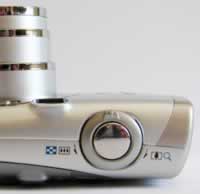 |
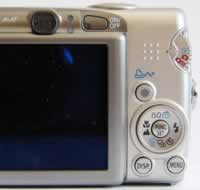
| Rear Controls | Perpetual Curve Design |
Flipping the Canon Digital IXUS 950 IS around to take a look at the rear, you find that aforementioned monitor screen, with the built-in speaker, viewfinder window and recessed on/off button top right. While this prevents accidental activation when the camera is in your pocket, it requires thumbnail operation, as do the even smaller controls bottom right of the LCD. These include a familiar four-way control dial veritably crammed with dual-purpose function icons, at the centre of which is the function set button. Press the latter in any of the shooting modes and an L-shaped menu appears to the left hand side of the screen. Not much has changed from the IXUS 800 IS, in that in all shooting modes, the essentials of resolution and file size are pre-determined here. Manual mode adds digital macro, colour accent, colour swap, stitch assist (to marry up panoramic shots), plus +/- 2EV exposure adjustment, the tweaking of white balance (unnecessary in practice unless aiming for a deliberate effect) plus access to the gimmicky 'My Colors' (including an even more 'vivid' vivid setting, plus separate control over RGB colour channels). In the same manual mode you can also access evaluative, centre-weighted or spot metering.
Press the upper half of the control dial and, in shooting mode, you can tab through the available ISO options. In auto mode you're offered just auto ISO or high ISO auto for low light, while switching to manual affords adds a broader range of ISO 80, 100, 200, 400, 800, or 1600 (its IXUS 800 IS predecessor stuck with a top ISO of 800). In playback mode the same upper press allows you to leapfrog 10 or 100 images, display all images in a particular category (such as 'people') or only those taken on a certain date � particularly useful if you're shooting on a 1GB or 2GB SD card and thus have captured 100's of shots. A right press of the same dial meanwhile affords access to the flash options. These are either auto or off in auto mode, and on, auto and off in manual mode. The red eye function is � unusually � separately activated or deactivated via the on-screen menu. The result was that I left it switched on at all times.
Pressing the bottom of the control dial calls up a toolbar down the right hand of the screen that allows the choice of single shot, continuous shooting or access to the self-timer � while in playback this is the means by which images are earmarked for deletion. Finally a press of the left hand section of the dial switches between infinity and manual focus for close ups. To effect any changes, simply press that function set button again. The above operation is reasonably straightforward and quickly becomes intuitive, even if the miniature controls make options a little fiddly to navigate � and I don't have large hands. Bottom left of the dial is the tiny display button, that either turns the screen off, or gets rid of the icons displayed thereon � including number of shots remaining, flash, ISO and shooting modes elected, plus image size, quality and metering. To the right of this button is a second, marked 'menu'. Press 'menu' when in image capture mode and you get access to three folders. The first contains the shooting options � including the ability to call up a nine section compositional grid on screen, or set the stabilisation feature to continuous, shoot only, or for use while panning. The second controls the set up options and the third more superfluously allowing the tweaking of operational sounds and images. Above the four-way control dial is a third and final button � the print/share button familiar to any Canon user.
 |
 |
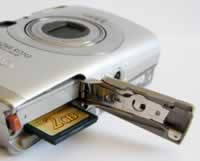
| Memory Card Slot | Battery Compartment |
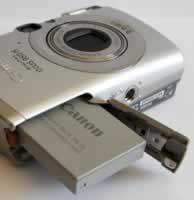
While the left hand side of the Canon Digital IXUS 950 IS � if still viewing from the back � is devoid of any catches or controls, the right hand side of the camera boasts a metal loop for attaching the supplied strap and a plastic cover for the AV out/USB ports, while the base of the camera features a screw thread for attaching an optional tripod. Nestling next to this is a spring-loaded compartment that you slide open to reveal a housing for both slim-line lithium ion rechargeable battery � the life of which is fair to good � and the SD memory card in use. Also located on the top right edge of the camera is a recessed, metal bottle top-style mode wheel. As you'd expect, this allows access to full auto shooting, manual shooting mode, pre-optimised scene modes, video clip capture and playback. This wheel is reasonably firm to the touch with a definite click as you ratchet through the settings, though it is easy to slip a step past your preference if turning it hurriedly to snatch that blink-and-you'll-miss-it photo opportunity.
Incidentally, the scene modes on offer are the regulars of portrait, night snapshot, kids & pets, indoor, the rather more usual creative light effect mentioned earlier, plus foliage, snow, beach, fireworks, aquarium, and underwater. Frustratingly, and as we found with the IXUS 800 IS, the optical zoom is disabled in video clip mode. In playback mode, you also get the chance to sort images into categories, record a sound memo, plus effect some basic image editing such as red eye correction (if needed), as well as call up a histogram and key file info. Again, all options are easy to navigate and the camera responds quickly to your button presses.
But how does the Canon Digital IXUS 950 IS fare when delivering stills? Is it a consummate performer, or is it let down by its 'mere' snapshot camera status? Read on to find out�
|
 PhotographyBLOG
is a member of the DIWA
organisation. Our test results for the Canon Digital IXUS 950 IS have been submitted to DIWA
for comparison with test results for different samples of
the same camera model supplied by other DIWA
member sites.
PhotographyBLOG
is a member of the DIWA
organisation. Our test results for the Canon Digital IXUS 950 IS have been submitted to DIWA
for comparison with test results for different samples of
the same camera model supplied by other DIWA
member sites.