
Canon EOS 400D Review
(also called the Canon Digital Rebel XTi)
Date: December 4th 2006
Author: Michael Roscoe
Leave a Comment about this Review
|
Introduction
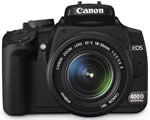
The Canon EOS 400D is the latest member of Canon's extensive range of digital SLRs. It is now over three years since Canon released their first entry-level DSLR, the 6 megapixel EOS 300D, which kick-started the whole budget DSLR boom. An entry-level camera, the new Canon 400D has a hard act to follow as it attempts to build on the success of the 300D and 350D models. The 400D closely follows the general design of the 350D, having similar compact proportions to the older model, but it adds some new features to try and remain competitive in what has become a rapidly expanding sector of the photography market. The Canon EOS 400D now has a 10 megapixel CMOS sensor, integrated cleaning system to prevent dust settling on the sensor, 9 point auto-focus system (borrowed from the more expensive EOS 30D) and larger 2.5 inch LCD sensor. The status LCD on top of the 350D's camera body has been completely removed, with the information now appearing on the LCD screen instead. Continuous shooting speed has been increased to 27 JPEG or 10 RAW images at three frames per second. It is now over three years since Canon released their first entry-level DSLR. The 6-megapixel EOS 300D kick-started the whole budget DSLR boom but the market has radically changed since then. There are now over half a dozen manufacturers all competing for this sector of camera sales, which directly benefits consumers as the latest models sport more features, higher megapixel counts and cheaper prices than ever before. Does the Canon EOS 400D still have what it takes to retain its place at the top? Find out now as we review Canon's new entry-level DSLR.
Compare Prices
Support PhotographyBLOG: Buy the Canon EOS 400D from one of our affiliate retailers:Features
The Canon EOS 400D has a 10.5 megapixel, 22.2 x 14.8mm CMOS sensor that delivers 10.1 effective megapixels. There are 2 image quality size settings available (Fine and Normal) and 6 image size settings ((LF) 3888x2592, (LN) 3888x2592, (MF) 2816x1880, (MN) 2816x1880, (SF) 1936x1288, (SN) 1936x1288)) which are recorded as JPEGs in the 3:2 aspect ratio. There is also a RAW format (3888x2592). A RAW and Large JPEG image can be recorded at the same time. The Canon EOS 400D uses the DIGIC II image processor. The lens mount is EF/EF-S and there is a 1.6x focal length factor with EF lenses fitted. The camera supports the CompactFlash Type I / II and Microdrive memory formats. There is a new Integrated Cleaning System to keep the Canon EOS 400D's sensor clean. The Self-Cleaning Sensor Unit shakes dust from the sensor with each power on.
The Canon EOS 400D offers Auto, Program AE, Shutter Priority AE, Aperture Priority AE, A-DEP and Manual exposure modes plus 5 different scene modes (Landscape, Close-up, Sports, Night Portrait, No Flash). There are 5 ISO speeds ranging from 100 to 1600 plus an Auto option. The Canon EOS 400D offers 3 different auto-exposure metering options - Evaluative metering (linked to all AF points), Partial metering at centre (approx. 9% of viewfinder) and Centre weighted average metering. Auto Exposure Lock automatically operates in the 1-shot AF mode with evaluative metering when focus is achieved, or manually via the AE lock button in creative zone modes. The camera offers exposure compensation in ± 2 in 1/3 EV stops.
The camera offers a 9-point auto-focusing system with 3 different modes - AI Focus, One Shot and AI Servo. The various AF points can be manually selected, or you can leave the it up to the camera. AF Lock allows you to lock the focus when the shutter button is pressed half-way in One Shot AF mode. Manual focus can be selected on the lens.
The shutter speed range is 30 secs. – 1/4000 sec in 1/2 or 1/3 stop increments, plus a Bulb mode for long exposures. There are 6 different White Balance presets to choose from (Daylight, Shade, Cloudy, Tungsten, White Fluorescent light, Flash), plus Auto and Custom settings. White balance compensation (Blue/Amber +/-9 or Magenta/ Green +/-9) and bracketing (+/-3 stops in full stop increments, selectable Blue/Amber bias or Magenta/ Green bias) are also available.
The Canon EOS 400D has a normal shooting mode, Self-timer (10 seconds) and a Continuous mode, which allows you take up to 3 frames/sec, maintained for up to 27 images (JPEG) and 10 images (RAW), until the memory card is full. Two different colour spaces, sRGB and Abobe RGB, are available, and there are 6 Preset Picture Styles with 3 user defined settings. Sharpness, contrast, colour tone and saturation are individually adjustable. There are 11 Custom Functions with 29 settings.
The built-in flash offers 4 different modes (Auto, Manual Flash On/Off, Red-Eye Reduction). The flash coverage is up to a 17mm lens and it has guide number of 13 at ISO 100. An AF assist beam, flash compensation of +/- 2 EV in 1/3 stop increments, Second Curtain Synchronisation, flash exposure lock and bracketing are all available. There is a hotshoe for external flashguns (E-TTL II with EX series Speedlites,wireless multi-flash support).
To compose your images, you can use the optical viewfinder, which offers 95% scene coverage and dioptre correction of -3 to +1 dpt. There is a depth of field preview button and an eyepiece shutter on the supplied camera strap. The Canon EOS 400D has a 2.5 inch colour TFT LCD monitor which has 230,000 pixels, a 160� viewing angle, offers 100% scene coverage and brightness adjustable to one of seven levels. A histogram showing overall brightness or RGB values is available in playback mode. The Canon EOS 400D supports the DPOF (Digital Print Order Format) and PictBridge printing standards, and it connects to a computer via USB 2.0.
The Canon EOS 400D's dimensions are 126.5(W) x 94.2(D) x 65(H) mm, and it weighs 510g without the battery and storage card fitted. The camera is powered by a Rechargeable Li-ion Battery or an optional AC Adapter. Battery life is 360 shots, measured according to CIPA standards. There is a metal tripod mount in the centre of the bottom of the camera.
|
 PhotographyBLOG
is a member of the DIWA
organisation. Our test results for the Canon EOS 400D have
been submitted to DIWA
for comparison with test results for different samples of
the same camera model supplied by other DIWA
member sites.
PhotographyBLOG
is a member of the DIWA
organisation. Our test results for the Canon EOS 400D have
been submitted to DIWA
for comparison with test results for different samples of
the same camera model supplied by other DIWA
member sites.