
GE E850 Review
Review Date: August 13th 2007
Author: Mark Goldstein
Leave a comment about this Review
|
Image Quality
All of the sample images in this Review were taken using the 8 megapixel JPEG setting, which gives an average image size of around 3Mb.
Noise
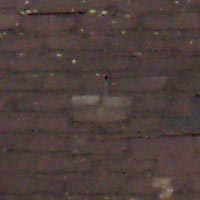
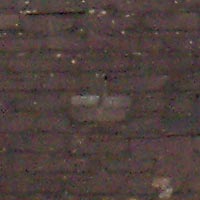
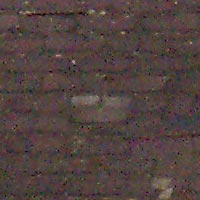
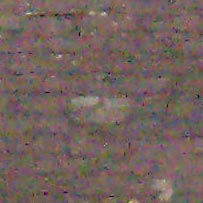
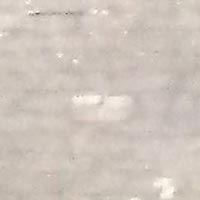
There are 6 ISO settings available on the GE E850 which you can select at any time if the camera is in the normal shooting mode. In terms of noise levels, the GE E850 is the worst performing camera that I have ever seen, with noise evident even at the slowest speed of ISO 80. ISO 200 is virtually unusable, whilst ISO's 400, 800 and 1600 should all be avoided. Here are some 100% crops which show the noise levels for each ISO setting:
ISO 80 (100% Crop) |
ISO 100 (100% Crop) |
 |
 |
ISO 200 (100% Crop) |
ISO 400 (100% Crop) |
 |
 |
ISO 800 (100% Crop) |
ISO 1600 (100% Crop) |
 |
 |
Sharpening
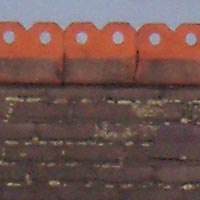
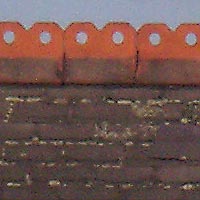
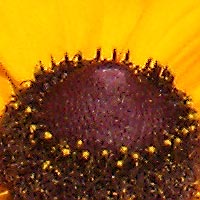
Here are two 100% crops which have been Saved as Web - Quality 50 in Photoshop. The right-hand image has had some sharpening applied in Photoshop. The out-of-the camera images are a little soft at the default sharpening setting. You can't change the in-camera sharpening level if you don't like the default look.
Original
(100% Crop)
|
Sharpened (100% Crop) |
 |
 |
 |
 |
File Quality
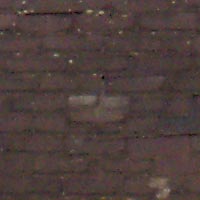
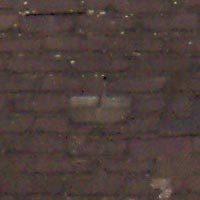
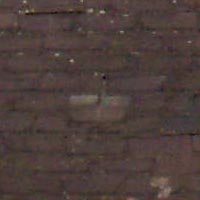
The GE E850 has 3 different JPEG file quality settings available, with 8M Best being the highest quality option. Here are some 100% crops which show the quality of the various options, with the file size shown in brackets.
|
8M
Best (3.9Mb)
|
8M
Fine (2.4Mb)
|
 |
 |
|
8M
Normal (1.1Mb)
|
|
 |
Chromatic Aberrations
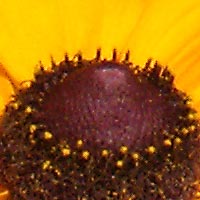
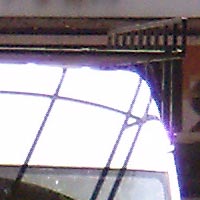
The GE E850 handled chromatic aberrations fairly well during the review, with small levels of purple fringing mainly present around the edges of objects in high-contrast situations, as shown in the example below.
|
Example
1 (100% Crop)
|
Example
2 (100% Crop)
|
 |
 |
Macro
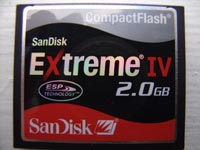
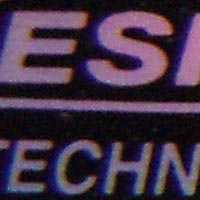
The GE E850 offers a Macro setting that allows you to focus on a subject that is 6cms away from the camera. The first image shows how close you can get to the subject in Macro mode (in this case a compact flash card). The second image is a 100% crop.
|
Macro Shot |
Macro Shot (100% Crop) |
 |
 |
Flash
The flash settings on the GE E850 are Auto, Red-Eye Reduction, Forced Flash, No Flash, Slow Synchro, Red-Eye Reduction+Slow Synchro. These shots of a white coloured wall were taken at a distance of 1.5m.
|
Flash Off - Wide Angle (28mm) |
Auto Flash - Wide Angle (28mm) |
 |
 |
|
Flash Off - Telephoto (140mm) |
Auto Flash - Telephoto (140mm) |
 |
 |
And here are some portrait shots. The Auto setting caused a tiny amount of red-eye, which the Red-eye reduction mode successfully removed.
|
Auto |
Auto (100% Crop) |
 |
 |
|
Auto & Red-eye reduction |
Auto & Red-eye reduction (100% Crop) |
 |
 |
Night Shot
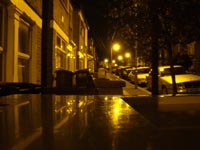
The GE E850's maximum shutter speed is 30 seconds, which is great news if you're seriously interested in night photography. Unfortunately the results are very noisy. The shot below was taken using a shutter speed of 10 seconds, aperture of f/5.6 at ISO 80. I've included a 100% Crop of the image to show what the quality is like.
|
Night Shot |
Night Shot (100% Crop) |
 |
 |
Overall Image Quality
The GE E850 produced images of poor quality during the review period. The GE E850 dealt fairly well with chromatic aberrations, with some purple fringing effects appearing in high contrast situations. The built-in flash worked well indoors, with no red-eye and average overall exposure. The night photograph was OK, with the maximum shutter speed of 30 seconds allowing you to capture enough light in most situations, but the resulting image was very noisy. Macro performance is average, allowing you to focus as close as 6 cms away from the subject. The 8 megapixel images were a little soft straight out of the camera at the default sharpening setting and ideally require some further sharpening in an application like Adobe Photoshop - you can't change the in-camera setting. The GE E850 main problem was with noise. The GE E850 is the worst performing camera that I have ever seen in this area, with noise evident even at the slowest speed of ISO 80. Anything above ISO 100 is a complete write-off, which limits this camera to good lighting conditions only.
|
 PhotographyBLOG
is a member of the DIWA
organisation. Our test results for the GE E850 have been submitted to DIWA
for comparison with test results for different samples of
the same camera model supplied by other DIWA
member sites.
PhotographyBLOG
is a member of the DIWA
organisation. Our test results for the GE E850 have been submitted to DIWA
for comparison with test results for different samples of
the same camera model supplied by other DIWA
member sites.