
Nikon Coolpix P5100 Review
Review Date: October 30th 2007
Author: Gavin Stoker
Leave a comment about this Review
|
Introduction
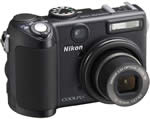
The Nikon Coolpix P5100 compact digital camera is the successor to the P5000, which is a mere 6 months old. The new P5100 improves on the older model by offering a 12.1 megapixel , 1/1.72-inch CCD sensor and the new EXPEED digital image processing engine for better looking images, even at faster ISO speeds. There's also a nifty distortion control feature that corrects for barrel distortion in images shot and even displays the corrected image on the LCD in real time. The lens is also now slightly wider (35-123mm) thanks to the larger sensor, but otherwise the P5100 is identical to its predecessor, with the same 2.5 inch LCD screen, Vibration Reduction to combat camera shake and ISO 3200 capability. Most 12 megapixel cameras that we've seen recently have struggled with image quality - is the new Nikon Coolpix P5100 any different? Gavin Stoker casts his steely gaze over the P5100 to discover the truth...
Compare Prices
Support PhotographyBLOG: Buy the Nikon Coolpix P5100 from one of our affiliate retailers:Ease of Use
So, is the Nikon Coolpix P5100, which upgrades the P5000, the ultimate enthusiast's compact, or simply an over engineered point and shoot hiding under a cloak of apparent sophistication? While it boasts thicker dimensions than your average slim line, fashion-conscious snapshot, plus larger than average 3.5x optical zoom with Vibration Reduction (VR) built in, pull the camera excitedly from the box and you'll find it's still remarkably diminutive. It just about fits completely in your palm � and it's certainly much more pocketable than Canon's chunky rival PowerShots. Additionally it is, in theory at least, a godsend for those looking for a practical alternative to lugging around either a 'super zoom' bridge camera or actual DSLR � provided you don't need a particularly long lens reach or too many bells and whistles.
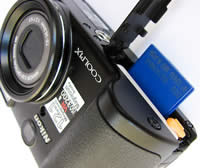
Pulling off with aplomb that manufacturer's trick of ensuring the camera feels at once solidly constructed yet at the same time reasonably lightweight, powered by wafer-like 3.7v lithium ion battery that slots into the base alongside optional SD media the P5100 boasts the kind of magnesium alloy chassis and rubberized grip normally found on Nikon's DSLRs. This has the effect of immediate reassurance. Don't forget also that its 12 megapixel maximum resolution � outgunning its dearer P5000's predecessor's 10MP offering � betters the company's current consumer-level DSLRs. The latest flagship Coolpix also retails for less than both its earlier sibling and for �100 below the excellent D40 in the UK (a suggested �299 in total). Which, considering its build, feature set and handling � and taken in comparison with what the same outlay would get you from rival manufacturers � means it seems very fairly priced.
The front 'business' end of the Nikon Coolpix P5100 features the aforementioned 35-123mm equivalent optic surrounded by a metal lens ring that can be unscrewed to allow for supplementary Nikon attachments such as wide angle or telephoto converters. Bottom left of this is a pin-prick like hole for the built-in microphone which delivers the usual slightly tinny, echo-y but perfectly acceptable sound, above which is larger single bulb that doubles as a self timer plus AF assist lamp. When acting as the latter, your subject is faced with a retina-searing bright orange beam. Above this again, you find the glass window for the optical viewfinder. It's rather murky, but peer through it (from the rear) and you can still spot visible barrel distortion at the lens' maximum wide angle setting, which appears slightly less pronounced on the LCD alternative. Directly right of this, but rather worryingly close to the lens, is a narrow strip that frames the built-in flash. Though our test shots reveal a commendable lack of red eye, as with most compacts, this didn't always prove to be the case.
 |
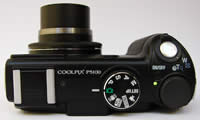 |
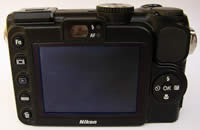
| Rear Controls | Top Controls |
On the front slope of the Nikon Coolpix P5100's grip is a springy shutter button with a definite halfway point � the camera taking a brief moment to determine focus and exposure but with no discernable shutter delay thereafter � surrounded by a zoom lever. Positioning the zoom control here has freed up space on the camera back for a rubberized indentation for the thumb, allowing for a firmer overall one-handed grip. The zoom is pretty quick to respond � even a slight nudge has it ratcheting back and forth, sound-tracked by a mechanical gnat-like buzz � which means that it's tricky to get framing spot-on in a single press. Still, this a minor irk. Maximum resolution JPEGS � there's no TIFF or RAW option here � are committed to memory in a couple of seconds, with the ability to capture three single shots in quick succession before the buffer memory is momentarily full. A reasonably generous 52MB internal memory cache is provided, though of course this can be supplemented by removable SD card. I used a 1GB Panasonic-branded SD class 2 for the duration of the test, using the camera intermittently over a two�week period. After which, it's worth noting, the P5100's battery was still going strong.
Just behind the shutter release button is a small but clearly marked on/off button with teeny but bright green adjacent lamp to signify power is indeed on. Give it a press and the P5100 powers up in around two seconds, the lens barrel extending to maximum wide-angle setting and the rear LCD blinking into life. Dwarfing this � and a great idea carried over from the DSLR � is a command dial. Immediately lending the camera 'grown up' feel, this falls readily under the thumb and, with the attendant 'fn' (or function) button held down, allows you to race through the likes of ISO or exposure settings on screen, or a whole sequence of images in playback. For the latter, a virtual rotating wheel of thumbnails appears on screen. The dial therefore provides a very neat solution that is wonderful to use.
Still atop the Nikon Coolpix P5100, but located slightly off-centre is a large-ish mode wheel, again similar to that you'd find on a consumer-level DSLR. Ranged around this we find the usual suspects of auto, program auto, shutter priority, aperture priority and manual, plus set up, video mode, scene modes, and finally a dedicated high sensitivity setting and anti shake/vibration reduction mode, denoted by the familiar wobbly hand icon. The action of the wheel itself is slightly stiff, meaning that you reach each chosen setting with a definite click and avoid accidentally shooting past that which you wanted. Next up atop the camera is a hot shoe for additional Nikon Speedlight flashgun, application of which would dwarf the actual model. And so to the back of the P5100, where you find the small window for the aforementioned optical viewfinder up top and dead centre, next to which are teeny flash and auto focus lamps but no diopter adjustment control. Below this is the 2.5-inch LCD. Though its dimensions may be nothing special these days, it does the job, meaning that at no time do you feel it's too small or too dim for either accurate shot composition or review. Its 230k-pixel resolution provides enough detail for you to be able to determine whether you have a sufficiently crisp image, though in playback, maximum resolution images do take a second to 'build' from low to high-res onscreen.
 |
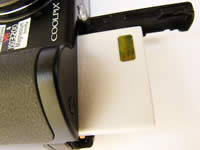 |
| Memory Card Slot | Battery Compartment |
To the left of the LCD is a vertical row of five buttons. The top is the function control, as we've already mentioned, the next one down controls the screen display � either displaying all settings, calling up a nine zone compositional grid, providing a 'clean' screen or switching it off entirely, but curiously no live histogram (although this button does call one up in playback mode). Fittingly the third button down sports the familiar playback icon, while the fourth is clearly marked menu. Press this when in auto capture and you're presented with a very limited choice: chiefly the ability to control image quality or size. Turn the dial to program and press again and you get a much more comprehensive array of control; including the ability to optimise the image in-camera � namely make it softer or, my favourite, more vivid, as well as capture shots in black and white � manually adjust white balance, metering, speed of capture, AF area mode (face priority setting included), flash exposure compensation and so on. In playback mode, pressing the same menu button affords access to rudimentary image editing, such as Nikon's exposure adjusting D-Lighting function, image slide show, plus the ability to minimize file size for email if required. The last button, at the bottom of the row, features the familiar trashcan icon for deleting images on the fly.
In general the Nikon Coolpix P5100 is quick to respond to the button presses, and its options and means by which these are displayed are clear and logical, leading us to find little fault here. Its uncluttered, unfussy feel continues when we move over to the right of the screen and find a familiar four-way controller that can be used for tabbing through images one by one or more precise selection of menu options, with an 'OK' button at its centre being the means via which changes can be implemented. Ranged around this are means of (in conjunction with the screen) changing the flash setting, adjusting exposure compensation, selecting self-timer option or switching to macro mode. On the right flank of the camera � if still viewing the camera from the rear � we find a catch or eyelet for attaching a supplied shoulder strap � although doing so looks slightly ridiculous on a camera of this size, meaning I tried it out and immediately removed it � plus a soft rubber cover for the A/V out/USB port. On the left hand flank of the camera is an identical means of threading on the strap, plus a built in speaker.
Using the Nikon Coolpix P5100 is something of a pleasure � it handles in a way that suggests an entry-level DLR has been shrunk and squeezed into compact casing. Sure, you don't get all the latter's bells and whistles, and at the end of the day the P5100 is best suited to snapshot photography, but which of us wants to lug a DSLR around all day and all night � or even take it out every single day when we're on holiday? But does the P5100 impress when it comes to delivering images � are they on a par with what could be achieved via a consumer level DSLR? Read on to find out�
|
 PhotographyBLOG
is a member of the DIWA
organisation. Our test results for the Nikon Coolpix P5100 have been submitted to DIWA
for comparison with test results for different samples of
the same camera model supplied by other DIWA
member sites.
PhotographyBLOG
is a member of the DIWA
organisation. Our test results for the Nikon Coolpix P5100 have been submitted to DIWA
for comparison with test results for different samples of
the same camera model supplied by other DIWA
member sites.