Nikon D80 Review
Review Date: November 13th 2006
Author: Michael Roscoe
Leave a Comment about this Review
|
Introduction
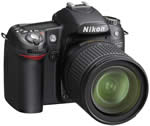
The Nikon D80 DSLR camera is aimed squarely at the enthusiast user. This new 10 megapixel model replaces the highly rated Nikon D70s and D70 and fits into the lower end of Nikon's DSLR product hierarchy, above the D50 and below the D200 and other professional camera bodies like the D2Xs. The DSLR market has undergone a radical transformation in 2006. These detachable lens cameras are no longer regarded mainly as a tool for the serious amateur or professional photographer. An increasing number of models are being released that target a much more varied customer base in the constant battle for sales and revenue. Currently Nikon and Canon dominate this product sector, and the release of every new DSLR from either manufacturer is anticipated and then scrutinized in equal measure. The Nikon D80 is clearly based on the older D70s, but also borrows a lot of features from the more expensive D200, making it an attractive proposition for the aspiring photographer. So does the Nikon D80 meet the demands of the enthusiast photographer that it's aimed at? Read our latest review to discover if the D80 is the DSLR for you.
Compare Prices
Support PhotographyBLOG: Buy the Nikon d80 from one of our affiliate retailers:Features
The Nikon D80 has a 10.75 megapixel, 23.6mm x 15.8mm RGB CCD that delivers 10.2 effective megapixels. There are 3 image size settings (3,872 x 2,592 [L], 2,896 x 1,944 [M], 1,936 x 1,296 [S]) and three levels of compression (Fine, Normal, Basic), which are recorded as JPEGs (8 bit). RAW (12 bit) format is also available, giving an image size of 3904 x 2616 pixels. The camera supports SD memory cards.
The Nikon D80 offers four advanced exposure modes - Programmed Auto [P] with flexible program, Shutter Priority Auto [S], Aperture Priority Auto [A] and Manual [M] - and 6 different scene modes (Portrait, Landscape, Macro Close up, Sports, Night landscape, Night portrait). Exposure compensation can be set up to +-5 EV in increments of 1/3 or 1/2 EV and auto-bracketing is available for 2 to 3 exposures in increments between 1/3 to 2.0 EV. There is also an auto-exposure and auto-focus lock button. The shutter speed range is 1/4000 - 30 sec with a Bulb option also available. There are 16 different ISO speeds ranging from 100 to 1600 in steps of 1/3 EV, plus HI-0.3, HI-0.7 and HI-1.
The Nikon D80 uses a TTL phase detection 11-point autofocus system with a detection range of EV -1 to +19. There are 3 different focusing modes available - Single Area AF, Dynamic Area AF, Auto-area AF - and 3 metering modes - 3D Color Matrix II, Centre-weighted metering and Spot metering. There are 4 types of focusing - Instant single-servo (AF-S), Continuous-servo (AF-C), auto AF-S/AF-C selection (AF-A) and Manual (M). The camera has 11 autofocus points which can be selected automatically or manually, and the center focus area can be switched from normal to wide-frame. Focus can be locked by pressing the shutter-release button halfway (single-servo AF) or by pressing the AE-L/AF-L button. An Auto-focus assist lamp is also available. For White Balance, there is an Auto setting, six manual modes with fine-tuning, color temperature setting (Kelvin), preset white balance and white balance bracketing.
The Nikon D80 offers single and continuous shooting modes with a maximum shooting speed of 3 fps for up to 100 consecutive JPEG images. The camera has a self-timer mode (2, 5, 10, and 20 second selectable), delayed remote mode and a quick-response remote mode. 32 different custom functions and Depth of field preview are also available. In-camera editing features include Nikon D-lighting, Red-eye Correction, Image Trimming, Image Overlay, Monochrome Black and White, Sepia and Cyanotype along with Skylight, Warm Tone and Custom Color filter effects. Also color, contrast and sharpening levels can be selected as well as various image parameters (Normal, Softer, Vivid, More Vivid, Portrait, Custom, Black and White).
The built-in flash offers a range of different modes; Auto, Fill-in flash, Red-eye Reduction, Red-eye Reduction with Slow Sync, SlowSync, Rear-curtain Sync and Off. It has a guide number of 13 and offers a Sync speed of up to 1/200 sec. Flash compensation is available in -3 to +1 EV in increments of 1/3 or 1/2 EV. The Nikon D80 has a hotshoe that accepts Nikon dedicated flashguns, either auto or manual.
To compose your images you use the optical viewfinder. The Nikon D80 offers 95% scene coverage and 0.94x magnification. The viewfinder has built-in diopter adjustment (-2.0 to +1.0m-1). To playback your images, the camera has a 2.5-inch, 230,000 pixel, low-temperature polysilicon TFT LCD with brightness adjustment and allows up to 170-degree viewing angle. PictBridge support allows direct printing with compatible printers, and the DPOF and PRINT Image Matching III features allow you to configure options for printing your images.
The camera's dimensions are 132(W) x 103(H) x 77(D)mm, and it weighs 585g without the battery, memory card, body cap, or monitor cover fitted. The camera is powered by either one rechargeable Li-ion Battery or six AA alkaline (LR6), Ni-MH (HR6), lithium (FR6) batteries, or nickel-manganese (ZR6) AA batteries. An optional AC adapter is also available. The camera can be connected to a television via either the NTSC or PAL video signal outputs. USB 2.0 allows for fast connection to a computer. There is a standard 1/4 inch metal tripod mount in the bottom-centre of the camera in line with the lens mount.
Finally, the standard box kit contains a Nikon D80 body, EN-EL3e Rechargeable Li-ion Battery, MH-18a Quick Charger, EG-D2 Audio Video Cable, UC-E4 USB Cable, Strap, Body cap, DK-5 Eyepiece Cap, DK-21 Rubber Eyecup, BM-7 LCD monitor cover, Accessory shoe cover and PictureProject CD-ROM. You will need to budget for some SD memory cards (at least 1Gb in size), as there is no card supplied or internal memory, which is typical of most DSLR cameras.
|
 PhotographyBLOG
is a member of the DIWA
organisation. Our test results for the Nikon D80 have been
submitted to DIWA
for comparison with test results for different samples of
the same camera model supplied by other DIWA
member sites.
PhotographyBLOG
is a member of the DIWA
organisation. Our test results for the Nikon D80 have been
submitted to DIWA
for comparison with test results for different samples of
the same camera model supplied by other DIWA
member sites.