
Olympus E-3 Review
Review Date: January 9th 2008
Author: Gavin Stoker
Leave a comment about this Review
|
Introduction
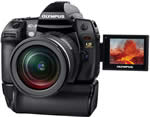
The Olympus E-3 is the new flagship of the Four Thirds Standard-based Olympus E-System. This long-awaited replacement for the original E-1 model offers a plethora of advanced features to tempt the professional photographer away from the competition. The E-3 boasts the world's fastest auto-focusing speeds when used in conjunction with the new Supersonic Wave Drive lenses, one of which we test out in our review (the 12-60mm SWD lens). Fast shutter speeds of up to 1/8000th second and 5fps continuous shooting with a 19 image RAW buffer ensure that you'll never miss a shot. A 10 megapixel Live MOS sensor, built-in image stabiliser which stabilises all lenses, Live View on a multi-angle 2.5 inch LCD screen and the Supersonic Wave Filter dust reduction system complete the headline specs. Olympus have taken a long time to get the new E-3 just right, but is it a case of too little, too late? Can the Olympus E-3 compete with and even surpass the likes of the Canon EOS 40D, Nikon D300 and Sony A700? Gavin Stoker got to grips with the E-3...
Compare Prices
Support PhotographyBLOG: Buy the Olympus E-3 from one of our affiliate retailers:Ease of Use
If the Olympus E-510 was an E-410 on steroids, the new flagship of the range, the semi-pro E-3, looks like it's swallowed both of them. Even without the Supersonic Wave Drive-equipped 12-60mm (28-120mm equivalent) ED lens supplied with our review sample attached, the E-3 is one chunky monkey. Bulkier also than Panasonic's new DMC-L10, with which it shares that useful flip out and twist LCD screen and Live View, the Olympus E-3 looks very much at home ranged up against the likes of the Canon 40D, Nikon D300, and Sony A700 � and, weighing them up in the palm, either matches or exceeds them for body-only weight. This is not a camera for those concerned about portability.
So much then for the apparent advantage of the Four-Thirds system in enabling lighter camera bodies and optics � in order to compete with the big boys in the enthusiast/pro market it's as if Olympus has decided its new camera has to be as physically demanding. But on the plus side, it feels as solid as you'd expect a camera retailing around the �1000 to be. Like its more user-friendly siblings, the Olympus E-3 is available either body only (for a suggested �1099 in the UK, which seems slightly on the dear side) or with a couple of lens kits (here the 14-54mm lens for approximately �1499, or the kit with the new 12-60mm lens � on test here � for around �1699).
So what of the other headline features? Thanks to a combination of the E-3's 11-point auto focus and its new Zuiko Digital Supersonic Wave Drive lenses, Olympus is here claiming the world's fastest auto focus speeds. A respectable 5fps performance in burst mode (up to 19 consecutive Raw images) and maximum shutter speed of 1/8000th sec further convey the impression that the Olympus E-3 is for more than just snapping the kids at play. There's a lot to examine on the E-3, too much in fact to go into close detail over here, so I'll try and provide an overview, picking out points of interest as we move along.
With a plethora of shooting settings displayed on the rear LCD screen upon start up, the Olympus E-3 is also a fairly busy looking camera with, at first glance, enough buttons and dials to get a Boeing 747 into the air. Though it may not be immediately obvious what task each of them performs, the main controls fall readily between thumb and forefinger. This ensures that you can actually get up and shooting fairly quickly, with enough of a rounded rubberised grip at the front, and gently curved panel at the rear, to get a firm hold even with that weighty optic attached.
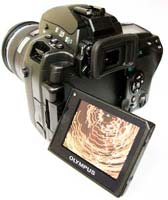
Sticking with ergonomics, the catches for attaching the supplied neck strap are set back in a recessed cavity so that you don't catch your fingers like on the E-410. That said, gripping it with both hands with the main LCD facing out at you, the glass of the screen inevitably soon becomes covered with thumbprints, though this is true of most DSLRs in its class. Luckily you can flip and twist the screen so it's facing inwards and use the optical viewfinder instead if this gets too irritating.
 |
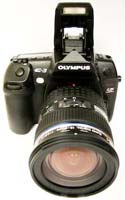 |
| Tilting LCD Screen | Pop-up Flash |
Live View, which is the ability to frame and check the focus of shots via the Olympus E-3's 2.5-inch HyperCrystal LCD, is, as last we found on the E-510, a real boon when it comes to attempting shots � such as our macro test shot, using the edge of a low desk as our 'tripod' � where it's either impossible or tricky to get your eye completely flush with the viewfinder (offering 100% coverage if you do). The ability to adjust the viewing angle of the screen when taking that awkward shot � a feature of some bridge cameras though still fairly unusual on a DSLR � seems to immediately make sense. Like those nik-naks you find in Ikea, it's the kind of feature you never knew you needed until you find yourself using it all the time � though admittedly the novelty aspect may play a large part.
Also shared with the E-510 is that impressively named Supersonic Wave Filter � whereby any dust particles that drift inside while changing lenses settle on a filter that protects the CCD, and are then shaken clear on the camera powering down. You additionally get built-in image stabilisation, with, again, a dedicated 'IS' button � here located just above the on/off switch, like Canon's 40D and Sony's A700, located near the base at the back � plus the same headline 10 megapixel resolution Live Mos sensor, backed up by Olympus' TruePic III image processing engine. Though it's not the most user friendly camera I've come across, once you've worked out how to implement the settings, the Olympus E-3 is fast, oh boy, it's Lewis Hamilton fast.
While the front of the camera is obviously dominated by the Four Thirds lens mount, top right of this, and hidden by a screw cap, is a means of attaching an external flash, directly beneath which is a self-timer/remote control lamp (incidentally no remote is supplied in the box), beneath which again � and snuggling in close to the lens � is the lens release button. Switching over to the other side of the lens mount � and still viewing the camera front on � we find, almost hidden, a preview button, whereby the viewfinder displays depth of field with the selected aperture value. As this is in a slightly awkward place for your fingers to find at the front, you can also 'thumb' the 'fn' (function) button top right on the camera back for the same purpose � just one of a variety of functions that can be assigned to it, including a means of assessing the white balance value; a sensor for this very purpose is located immediately above.
To the left of this sensor, and on the foremost point of the rounded grip, is a sub command dial � useful if you find it easier to drop your forefinger forward of the main shutter button to effect a mode or menu change, rather than rotating the main command dial at the rear with your thumb. Both offer an amount of resistance that feels just right. The Olympus E-3 is what could be described as 'butter-off-a-hot-knife quick' in determining focus, and, with a flick of the on/off button, you can be taking a photo as fast as it takes you to press the shutter button.
Next we move to the top of the camera, which is where � especially with the top LCD display window/control panel lit up with settings � the Olympus E-3 starts to look Piccadilly Circus busy. To the far left, and in the absence of a chunky mode dial/wheel as such, there's a mode button serving the same function. Hold this down and turn the rear command dial to race through the familiar P,A,S,M settings, or hold down the adjacent 'AF' button to toggle between the focus modes � all displayed in the large LCD window atop the camera. This is a feature that was lacking on both the cheaper E-410 and E-510, but again it's one here that falls into line with the E-3's main competitors.
 |
 |
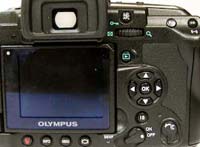
| Rear Controls | Image Info |
Just forward of these two buttons is a third, for selecting from the comprehensive range of on-board flash settings as well as controlling their intensity. Hopping over the hood for the pop up flash � larger and sitting more proudly than that offered by the D300, A700, 40D or L10 � we find a hot shoe for supplementary flash, and come to the aforementioned status display window (Olympus prefers to call it a 'control panel') which takes up most of the right hand flank. Just in front of it is a row of four further buttons.
Moving from left to right the first is the self-explanatory light button for illuminating the status display window, next to which is a dedicated white balance (WB) control for manual adjustment. The hard copy manual makes plain that when there's no near-white colour presented in a scene, the camera won't correctly determine what it should be � hence the ability to select from a preset white balance. The occasional duff white balance was a feature of the E-410 and E-510, so it appears Olympus hasn't yet cracked that bugbear. The third button along is again familiar, and is for adjusting exposure compensation, while the forth is for flitting between the plethora of ISO settings � one of the broadest ranges I've encountered on a DSLR. Though it starts at bog standard ISO 100 (there's no ISO 64), you get 16 incremental settings all the way up to ISO 3200 that should satisfy most users. Better still, at its top setting the Olympus E-3 doesn't suffer as visibly from either noise or noise reduction as most digital cameras, meaning it may be a setting actually worth having rather than a step too far simply to bump up the on-paper spec.
Moving to the back of the camera, and above the reasonably clear � but again info crammed � 2.5-inch LCD screen, we find the optical viewfinder with quite a pronounced rubber eyecup. Far from being small or murky, the viewfinder itself actually appears large and clear, with that aforementioned 100% field of view, the 11 focus points clearly delineated, and the shooting information that runs along the bottom in green LED bright and visible. Also worth mentioning as regards the main LCD below it is that it features an illumination sensor that automatically measures the lighting conditions at the time and tweaks visibility as necessary. Since I didn't find visibility suffering, I can only conclude that it works rather well.
As you'd expect, next to the eyepiece is a diopter adjustment dial to ease the plight of the myopic � but, somewhat ironically, it's partly hidden by the eyepiece, so quite fiddly to get at. To right hand side of the viewfinder we find a dual-purpose auto exposure/auto focus lock button, or triple purpose, as it's also a means of protecting images from accidental deletion in playback mode. Beneath this is the main command dial, which we've touched on already, and ditto the function button to its right. To the right of this again is a curiously marked button that reveals itself as a means of switching between single target AF mode and 'all target': the camera automatically focusing on the subject in front of it from among 11 AF targets.
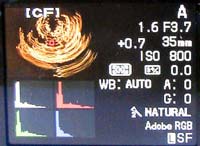
Directly beneath the main command dial on the Olympus E-3's back � and, again, it feels slightly hidden � is the main playback button. A press of this brings up not just the captured image, but rather a thumbnail of the image surrounded by a plethora of file info, including histograms for individual colour channels. To check the fidelity of the shot you use the command dial (again) to zoom in closer, while the four way control pad just below (with familiar centrally-placed 'OK' button) can be utilized for panning around the captured shot. All controls respond well and operation is fairly fluid.
 |
 |
| Battery Compartment | Memory Card Slot |
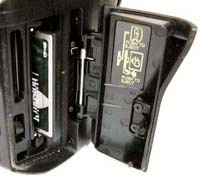
Underneath the four-way pad is that dedicated 'IS' button. This either turns stabilisation on or off, or turns off the horizontal image stabilizer but leaves on the vertical one � for when you want to pan with your subject and keep them sharp while the background blurs. Below this again is the firm on/off switch, to the right of which is a similar control for popping open the right hand side memory card compartment. Once again Olympus offers a choice of both CompactFlash or (the surely-almost-dead) xD-Picture Card format.
So, we come to the final controls at the rear of the Olympus E-3. To the right of the on/off switch is a teeny indicator bulb marked 'SWFF', which doesn't stand for some American music festival but rather an indication of the fact that its Supersonic Wave Filter is in the process of doing its funky stuff. Left again � and tucked just beneath the LCD � is a small button for activating the Live View function, denoted merely by a screen icon. Given that this is one of the camera's major selling points, why Olympus didn't see fit to simply mark it 'Live View' � as on Panasonic's new L10 � I don't know. Rather than highlighting a major feature, as I say, it is literally tucked away.
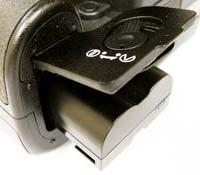
Next up, and more definitively marked, is the menu button � on-screen options are clearly presented even if the interface is quite utilitarian � and left again, the info button. Press this if you momentarily want a 'big hit' via the LCD of all the settings selected at that one point in time. For the occasional duff shot, you get a button marked with a red trashcan icon as the fourth and last button on the back. On the left flank meanwhile we find a screw cover for a remote cable connector and separate rubber flaps that hide the video out and USB ports, and a 9-volt DC-in port. And last, but by no means least, at the camera base we discover a screw thread for a tripod, and a lockable flap covering the battery compartment.
The overall impression the Olympus E-3 gives off is of a fast and fully featured camera that will initially present quite a learning curve for those trading up from a consumer level DSLR � so, this is not at all a model for the point and shoot brigade. Its ruggedly built � not to mention splash proof � body and myriad controls further the feeling of serious intent, but a small voice inside me wonders if there isn't so much technology on offer � with options to the nth degree � that it's in danger of getting in the way of old-fashioned creativity. This camera feels as much a statement of intent as a viable workhorse.
So what of the true tester, the Olympus E-3's images themselves � does it come up trumps under most given conditions, struggle to get an accurate white balance like the E-410 and E-510, or has Olympus surmounted that particular gripe � crucially, given that this is its flagship semi pro offering? Carry on reading to find out.
|
 PhotographyBLOG
is a member of the DIWA
organisation. Our test results for the Olympus E-3 have been submitted to DIWA
for comparison with test results for different samples of
the same camera model supplied by other DIWA
member sites.
PhotographyBLOG
is a member of the DIWA
organisation. Our test results for the Olympus E-3 have been submitted to DIWA
for comparison with test results for different samples of
the same camera model supplied by other DIWA
member sites.