
Olympus E-400 Review
Review Date: January 25th 2007
Author: Michael Roscoe
Leave a comment about this Review
|
Introduction
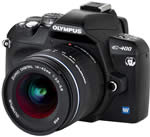
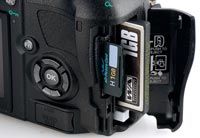
The Olympus E-400 has a unique claim to fame - it's currently the smallest and lightest digital SLR camera in the world, weighing just 375g and measuring 129.5mm (W) x 91mm (H) x 53mm (D). Inside this diminutive body is a 10 megapixel sensor, 31 automatic shooting modes, 2.5 inch LCD screen and built-in dust protection via its Supersonic Wave Filter. The Olympus E400 is a Four Thirds Standard-compatible camera that can be used with all of the existing E-system lenses, flashguns and accessories. The E-400 has dual memory card slots for xD-Picture Card and CompactFlash cards, built-in pop-up flash, a continuous shooting mode of 3fps with up to five images when shooting RAW, depth of field preview, and 49 segment digital ESP and spot metering. The combination of small body and E-system lenses has led Olympus to claim that the E-400 is the "perfect travel companion", but does it deserve a place in your camera bag? We reviewed the Olympus E-400 to find out.
Compare Prices
Support PhotographyBLOG: Buy the Olympus E-400 from one of our affiliate retailers:Ease of Use
Olympus has a long and respected DSLR heritage, but, in the hyper-competitive digital age, their sales figures have been running behind the big two � Nikon and Canon. However, while they only have a comparatively small slice of the DSLR market, one thing they cannot be accused of is complacency. It was in 2002 that Olympus announced a clear future strategy for their DSLR products and built all their DSLR models around the Four Thirds System. They were also the first to offer features like an adjustable, live-preview screen and unconventional designs like the E-300 using the Porro mirror viewfinder system. This innovative approach to DSLR production is now being upheld with their latest camera, the Olympus E-400, heralded as the World's smallest DSLR.
Olympus has stated that the E-400 marks the start of a new series of cameras that complement their budget E-500, the enthusiast level E-330 model and the professional E-1 series camera. Its unique selling point seems to be its diminutive size. Once unpacked, its proportions make DSLRs that were previously considered small, like the Canon EOS 400D, look large and bulky. A few quick measurements reveal that it is, in fact, marginally longer than its Canon rival, but its body is considerable smaller in both width and height.
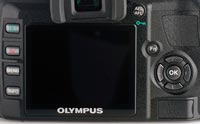
One noticeable area where Olympus has trimmed the E-400's proportions is with its almost non-existent grip. Photographers with goalkeeper sized hands might find handling less secure than when using larger models, as the only way to grip it is to use a thumb, index and middle finger. That said, its low weight means it is actually easy to hold for extended periods of time, making it also possible to operate one-handed. The body itself feels solid enough with no rattles and it appears well weatherproofed. The dials and controls do not seem scaled down, as they are straightforward to operate and logically located for easy, intuitive use. The rear of the E-400 features a four-way controller, seven buttons, and a fixed 2.5-inch LCD with a more than satisfactory 215,000-pixel resolution.
| Rear Controls | Top Controls |
 |
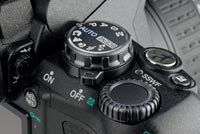 |
In just over a second, after an anti-dust system is activated when switching the Olympus E-400 on, it is ready for action. Beginner DSLR users will appreciate the extensive nineteen auto-scene modes. These include the usual portrait and landscape choices, as well as some more unusual options, like a DIS mode to reduce blur when capturing moving subjects and high and low key settings that enhance bright or dark scenes. These auto modes are simple to select by adjusting the mode dial on the top plate to Scene and scrolling through the easy to use menu options displayed on the LCD. It is also possible to choose one of six auto-exposure settings using the mode dial and there are all the (PASM) manual and semi-automatic options that you would expect on a detachable lens camera.
Altering the shutter and aperture in respective priority modes is achieved by adjusting another dial on the top plate and the same dial is used for manual exposures in conjunction with the +/- button conveniently positioned next to the shutter button. The Olympus E-400 also offers a notable +/- 5-stop exposure compensation range and there are an adequate three auto-focus points that can be selected in auto and manual modes. The focusing can be bit noisy but it is swift enough and accurate in normal bright illumination. One drawback with the Olympus Four Thirds System is the fact that it has a physically small CCD, which can make the viewfinder area feel cramped and limited, but it does have 95% coverage of view on recorded images.
Sports and action photographers should be satisfied with the three frames per second capability but the E-400 only enables five shots in a row on its continuous drive mode before it locks up for several seconds when recording to its high-resolution (SHQ) JPEG and RAW file settings.
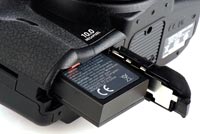
| Memory Card Slot | Battery Compartment |
 |
 |
The Olympus menu system takes some getting used to and is not the most logical to operate. The main screen has five tabs along the side of the display enabling users to scroll through and adjust the camera set-up and picture settings. There is a selection of five colour settings including vivid, natural and monotone choices, plus four image quality settings and the chance to save JPEG and RAW files simultaneously.
The Olympus E-400 can cope with a wide range of bright and dull lighting conditions as it has an ISO range from 100-1600, in an impressive thirteen increments. Pressing the Info button enables users to get a shortcut to the camera settings with access via a single screen on the LCD. Here it is straightforward to change one of the ten options, including five metering and AF modes and ten white balance choices, by using the four-way controller. For more advanced control, users simply have to press the info button a second time for options including contrast, sharpness, gradation and color space choices.
Viewing the HyperCrystal LCD in normal or bright daylight illumination is trouble-free as it can be seen at even oblique angles. It offers decent resolution in which to view photographs in a set of four, nine, or sixteen. It is easy to zoom into a single image up to fourteen times using the control dial on the top plate. It's also possible to get exposure feedback by pressing the Info button for a histogram display as well as to see EXIF info, and there is a flashing warning to highlight the over or underexposed parts of an image.
The Olympus E-400 provides a surprisingly good handling experience considering its compact size. Experienced DSLR users might feel it is too small to use as a their principal camera, but it would make a superb back-up for consumers with the spare cash. Travel photographers, or practitioners wanting a discreet camera to shoot candid or urban images will find that the E-400 is just this compared to traditional bulky DSLRs. Newcomers to detachable lens cameras won't find much to grumble about, as this model is the perfect introduction to this product genre. The Olympus E-400 is simple to use, but it has all the advanced capabilities that even the most demanding enthusiast could want.
|
 PhotographyBLOG
is a member of the DIWA
organisation. Our test results for the Olympus E-400 have
been submitted to DIWA
for comparison with test results for different samples of
the same camera model supplied by other DIWA
member sites.
PhotographyBLOG
is a member of the DIWA
organisation. Our test results for the Olympus E-400 have
been submitted to DIWA
for comparison with test results for different samples of
the same camera model supplied by other DIWA
member sites.