
Panasonic Lumix DMC-FZ28 Review
Review Date: September 15th 2008
Author: Mark Goldstein
Leave a comment about this Review
|
Introduction
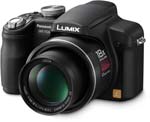
The new Panasonic Lumix DMC-FZ28 is the successor to the popular, one-year-old FZ18 camera. The defining feature of the Panasonic FZ28 is still its massive 18x zoom lens, now equivalent to a slightly wider-angle 27-486mm focal length. The FZ28 is a bridge-style compact camera, looking just like a true DSLR at first glance, but featuring a non-interchangeable lens instead. The Panasonic DMC-FZ28 offers an increase to 10 megapixels, larger 2.7-inch LCD screen, new Venus Engine IV processing engine which promises better low-light performance, and updated iA (intelligent auto) mode with newly added AF Tracking function. The FX28 can also shoot high-definition 1280 x 720p video at 30fps, making it a viable alternative to a dedicated video camcorder, and it retains the optical image stabiliser, face detection, RAW mode and ISO 1600 at full image resolution from its predecessor. Retailing for �329.99 / $399.95, find out if the FZ28 is a worthy successor or just a modest upgrade...
Compare Prices
Support PhotographyBLOG: Buy the Panasonic Lumix DMC-FZ28 from one of our affiliate retailers:Ease of Use
Costing exactly the same as its predecessor did on launch, the new Panasonic Lumix DMC-FZ28 is even more firmly in the firing line of the budget DSLR camera. There's obviously still a market for bridge cameras and so-called 'super zooms' though, with Olympus and Fujifilm also releasing updated versions of their comparable models, the SP-570 UZ and S8100fd respectively, and Nikon hoping to steal their thunder with the Coolpix P80. So it seems that at least someone is still after a big zoom on a small-ish body. The theory is, when you've got such a lens reach and a smattering of real photographic control on board, why would you need an interchangeable lens camera anyway?
As the Panasonic Lumix DMC-FZ28's asking price is �330 in the UK, however, a hard decision must be made. It's not such a financial stretch to the likes of the Nikon D60 or Canon EOS 1000D instead, albeit only with a standard zoom lens. Still, Panasonic's camera does offer the best of both worlds: 27mm equivalent at the wide end going all the way up to 486mm at maximum telephoto, allowing for (in theory) a very creatively flexible capture device. And, whether you already own a DSLR or not, anybody who has used an all-encompassing super-zoom will appreciate that then swapping back to a 3x zoom � the range typically offered by digital compacts and standard DSLR kit lenses � is a frustrating experience.
Available either in black or silver, the more serious-looking former version was supplied for this review, and boasts both a 'DSLR-lite' shape and styling. While resembling a diminutive DSLR, the Panasonic Lumix DMC-FZ28 is dominated by the inclusion of that 18x zoom lens, thankfully with on-board 'Mega O.I.S' (optical image stabilization). A stubby barrel encases and protects the optic when not in use and an equally good-sized grip with tactile, leather-effect detailing houses the battery pack in its base. Nice to see a chunky lithium-ion rechargeable battery fitted as standard when many bridge models seem to think that four bog-quality AAs will suffice to get you going out of the box.
While this is not a camera for slipping into a pocket by any means, the all-plastic Panasonic Lumix DMC-FZ28 feels like it could withstand the odd glancing knock, though I wouldn't like to vouch for dropping it onto concrete. The camera feels solid and rugged in the palm, while at once portably lightweight � a slightly contradictory sounding summation that translates as build quality being 'as it should be'. Pleasing also to find a viewfinder � here electronic (EVF) � with an eye relief that juts out clear of the LCD so that you don't automatically smear your nose all over the monitor when you put your eye close to it. There's also a dioptre adjustment wheel immediately adjacent, enabling the short sighted to use it without clashing spectacles. To avoid flare, you also get a detachable lens hood in the box, and clip-on lens cap that you can attach via a thread to one of available catches for a shoulder strap.
 |
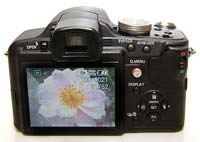 |
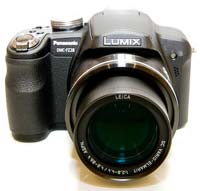
| Front | Rear |
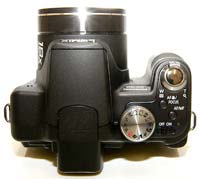
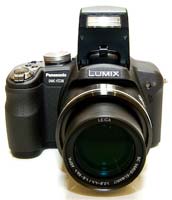
In being dominated by that big lens, the front of the camera is very spare looking, save for a lamp for the AF assist light/self timer to the right of the lens (if viewed head on), and below this pin holes for the Panasonic Lumix DMC-FZ28's built-in speaker. Above the lens is a swift access pop up flash (with a dedicated activation button sitting just behind it at the rear), but no hot shoe for mounting a supplementary flashgun. The flash coverage has been significantly improved, offering a maximum range of 8.5m. Moving to the top of the camera, controls start to get a little busier, but not overwhelmingly so. Here you find a comprehensively featured mode wheel with 14 shooting options. This demonstrates a nice firm action as you twist it around to your chosen setting, and a definite click as you line up each. Note that the Playback option has now been relocated to a switch on the rear of the camera.
Ranged around the wheel are the usual suspects of program, aperture priority, shutter priority and manual modes, movie mode, scene modes, night scene, sports, landscape, portrait, plus two for attributing custom settings, and finally Panasonic's much talked about Intelligent Auto Mode. Panasonic have tried to make things as easy as possible for the complete beginner by providing this shooting mode, which allows you to point and shoot the camera without having to worry about choosing the right mode or settings. Intelligent Auto Mode automatically determines a number of key criteria when taking a picture, including selecting the most appropriate scene mode (from 5 commonly used presets) and ISO speed, and turning face detection (up to 15 faces, even sideways on), image stabilization and quick auto-focus on. The Intelligent Auto Mode now includes Intelligent Exposure, which increases exposure only in the under-exposed areas of the image, Digital Red-eye, which automatically detects and removes red-eye, and AF Tracking, which continually tracks a moving subject and keeps it in focus, without you having to hold the shutter button halfway down as on most other cameras. Also catering for the beginner are a total of 21 scene modes, including new Pin Hole and Film Grain modes that add unique, film-camera-like effects to your images (quirky rather than useful). All very useful for the novice user.
In practice the Intelligent Auto Mode system works very well, with the camera seamlessly choosing the most appropriate combination of settings for the current situation. The 5 available scene modes are Portrait, Landscape, Macro, Night Portrait and Night Scenery, so obviously not all situations are covered by Intelligent Auto Mode, but it does work for the majority of the time. It makes it possible for the less experienced photographer to easily take well-exposed, sharp pictures of people, scenery and close-ups by simply pointing and shooting the camera. Also worthy of mention are the much-improved white-balance options. As well as the usual range of presets and Auto options, you can now set the camera using two measured white balance settings, providing useful shortcuts if you commonly shoot in mixed lighting conditions not covered by the presets. In addition, the new Colour Temperature option allows you to dial-in an exact Kelvin value - you effectively get a white-balance preview via the LCD screen.
Adjacent to the mode wheel is an on/off slider switch. Flick this to on and the camera powers up in around 1.5 seconds, the rear LCD bursting into life and that zoom extending to maximum wide angle setting, slightly proud of its protective barrel. The Panasonic Lumix DMC-FZ28's auto-focus system is fast to determine focus and there's no shutter delay to speak of when you take a shot, and full 10 megapixel resolution JPEGs are committed to memory in just over a second. You can now also take more than three regular stills in quick succession without causing the camera to freeze up momentarily while the buffer memory is cleared, as on the older DMC-FZ18. RAW performance has also been significantly improved too. On the FZ18 it took up to 5 seconds to save a RAW file in single shot mode and 8 seconds for a combined RAW + JPEG (even slower when saving to the camera's built-in memory. The new Venus Engine IV processor on the DMC-FZ28 has improved these timings to 2 and 3 seconds respectively.
Just forward of the on/off slider is a small button marked AF/MF that allows manual adjustment of the AF area or the focus range to be manually set at between 1ft and infinity, the central portion of the frame enlarged so sharpness can be more accurately determined. Again, it does the job it's supposed to do. Just forward of this again is a dedicated macro AF button that lets you set the focus point anywhere in the frame � useful should you be shooting for example in anything other than Intelligent Auto mode � and just in front, at the start of the slope that forms the top of the camera grip, the main shutter button. Springy to the touch, this is encircled by a lever for operating the zoom, the action of which is impressively smooth and mechanically quiet.
 |
 |
| Top | Pop-up Flash |
The HD video capability of the DMC-FZ28 is one of the major new features of this model. The HD movie mode records 720p video at 1280x720 pixels at 30 fps. Movies are saved in the Quicktime .MOV format, which is fine for the smaller sizes, but less so for the HD video - our 20 second sample movie is a whopping 58Mb, and you'll only be able to fit around 10 minutes of HD footage on a 2Gb SD card. Panasonic would have been better advised to employ a more efficient video codec. On a more positive note, sound is recorded during capture (although as with most digicams it's on the muffled side) and, like the DMC-TZ3, you can now also use the zoom lens and really make the most of that huge focal range. Back to the minus points though, as you'll find that the lens zooms a lot more slowly than when shooting a still image, and if you choose continuous auto-focus, areas of the video will be blurred before becoming sharp again as the camera tries to refocus.
As with all current Panasonic models, the FZ28 has an anti-shake system, dubbed Mega O.I.S. Turn it on and the Panasonic Lumix DMC-FZ28 automatically compensates for camera shake, which is a slight blurring of the image that typically occurs at slow shutter speeds when the camera is hand held. There are three different modes, Mode 1 is on all the time including image composition, Mode 2 is only on when you press the shutter button, and there's also an Auto mode. In practice I found that it does make a noticeable difference, as shown in the examples on the Image Quality page. You don't notice that the camera is actually doing anything different when anti-shake is turned on, just that you can use slower shutter speeds than normal and still take sharp photos. Thankfully leaving the anti-shake system on didn't negatively affect the battery-life, with the camera managing just over 400 shots using the supplied rechargeable Li-ion battery.
Panasonic also provide a High Sensitivity mode to help combat the effects of camera shake. When this scene mode is selected, the camera automatically raises the ISO speed from 1600 up to a maximum of 6400 and therefore allows for a faster shutter speed. This mode allows you to handhold the DMC-FZ28 without using the flash and get more natural results, whilst at the same time freezing subject movement more successfully. There are some obvious drawbacks with this special scene mode, principally a significant reduction in resolution to a maximum of 3 megapixels in the 4:3 aspect ratio, and the Quality is also set the the lowest level. The user guide states that "you can take pictures suitable for 4x6 inch printing" using the High Sensitivity mode. You also need to select the right scene mode and therefore have some idea about when it is applicable to your subject.
The Intelligent ISO mode is the third way in which the DMC-FZ28 attempts to avoid subject blur in low-light conditions. The camera automatically sets the appropriate shutter speed AND ISO speed for the subject that you are taking pictures of. So if you're taking shots of a child indoors, the DMC-FZ28 automatically raises the ISO and in turn the shutter speed to avoid blurring the child's movement. If the subject is still, then the camera chooses a lower sensitivity and slower shutter speed. It's a clever idea that works well in practice, with the camera generally choosing an appropriate combination of shutter and ISO speed. You can also limit the maximum ISO speed that the camera can choose, which I'd strongly advise, as the fastest available setting of ISO 1600 produces very noisy images - ISO 800 is a better choice.
Moving around to the back of the Panasonic Lumix DMC-FZ28, we find the left hand side dominated by a slightly larger, higher-resolution 2.7-inch, 230k pixel LCD monitor, which is bright and clear as a means of composition whether shooting inside or out. If visibility does suffer in sunlight � not something I personally found a problem � there's the option to switch to the electronic viewfinder via a dual EVF/LCD button, though 90% of the time the LCD was the preferred method of composition. One easily-overlooked but significant improvement on the DMC-FZ28 is the addition of a Camera / Play button on the rear, which enables you to quickly and easily switch from shooting to playback without also changing the shooting mode.
 |
 |
| Memory Card Slot | Battery Compartment |
Just right of the viewfinder, like you'd find on a budget DSLR, is an AF/AE lock button, below which is an easy-to-overlook joystick, though it's so small and slightly fiddly that it should perhaps be renamed the 'joy-less' stick. Press this down, hold it, and a pull down menu containing a smattering of useful settings appears on screen to save you having to delve into the main menus for similar. This enables on-the-fly access to an Aladdin's cave of options, including the important likes of image stabilization mode � a choice of two modes (activated at the time you press the shutter or on continuously) � auto focus areas (or opt for face detection mode), metering (spot, centre weighted and average), manual white balance, ISO, image resolution and image quality, intelligent exposure and LCD mode. Like other Panasonic Lumix compacts you get the choice here to brighten the overall display ('power LCD' mode) or opt for the more useful high-angle setting, which aids screen visibility when you're holding the camera at arm's length for a shot over the heads of a crowd.
Beneath the stubby joystick is the display button. A quick press either activates or deactivates the number of shooting settings displayed on screen, calls up a live histogram alongside them or displays a nine zone compositional grid for those experimenting with the Rule of Thirds. Below this control is an identically sized button marked with the familiar trashcan icon for deleting unwanted shots quickly. This button also serves a dual purpose as a short cut to continuous shooting. There are two fairly average settings: 'normal' or unlimited � the former can shoot at up to 2.5fps for 3 images in Fine JPEG mode, the latter 1.8fps to the maximum capacity of the card, both of which are slower than on the older FZ18 camera.
To the right of this we discover the familiar four-way control pad that you'd expect to find on most digital cameras. At its heart is a menu/set button, for, yes, calling up the user-friendly if uninspired looking regular menus on the LCD screen. The menus comprise two separate folders; one for shooting/playback options � dramatically pared down if you're using Intelligent Auto mode � the other the generic set up menu. A subsequent press when you've located the various options goes on to effect any changes, which are quick and precise. Ranged around this central menu/set button are four pads. Although these are used for tabbing through menu options or captured images, press them when in capture mode (and you haven't summoned up a menu) and, starting from the top, you find an exposure compensation button. Continue clockwise and you find one for accessing the flash settings, a third for the new Function option, which can be configured to activate one of seven key settings (I chose ISO speed), while the fourth provides access to the self timer options.
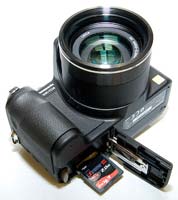
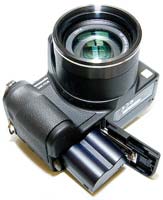
At the base of the camera we find a screw thread for a tripod, alongside which is a sliding compartment that houses both the chunky rechargeable battery � necessarily providing a good long life as there's no optical viewfinder to fall back on as a power saver � and a slot for an optional SD card (or the higher capacity SDHC). Apart for a slot for threading through a strap, the right hand side of the camera also houses the new Component Out socket for connecting the FZ28 to a HD television or monitor. Unfortunately, Panasonic have decided to cut costs and not include a component cable as standard in the box, which means that you'll have to purchase one separately to take advantage of this camera's HD connectivity. The left hand side of the unit (if viewed from the back) features a flip open door hiding the AV out port and DC-in. A Lumix-branded charger is provided in the box for removing and boosting the aforementioned lithium-ion battery.
In summary the DMC-FZ28 is outwardly very similar to its predecessor, but offers quite a large number of subtle internal changes that collectively add up to make it slightly easier to use, especially for beginners thanks to the improved Intelligent Auto mode.
|
 PhotographyBLOG
is a member of the DIWA
organisation. Our test results for the Panasonic Lumix DMC-FZ28 have
been submitted to DIWA
for comparison with test results for different samples of
the same camera model supplied by other DIWA
member sites.
PhotographyBLOG
is a member of the DIWA
organisation. Our test results for the Panasonic Lumix DMC-FZ28 have
been submitted to DIWA
for comparison with test results for different samples of
the same camera model supplied by other DIWA
member sites.