
Pentax K100D Super Review
Review Date: October 22nd 2007
Author: Gavin Stoker
Leave a comment about this Review
|
Introduction
Compare Prices
Support PhotographyBLOG: Buy the Pentax K100D Super from one of our affiliate retailers:Ease of Use
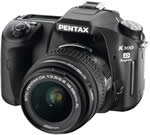
Generally speaking, when a deal looks too good to be true it usually is, and so we approach the Pentax K100D Super, bundled with 18-55mm standard lens for an asking price a penny shy of �400 in the UK, with a degree of caution and not a little anticipation. That's roughly �200 less than the plain old K100D was on launch, and this one has the added � though perhaps extraneous � bonus of a dust removal system this time around.
Although there may be nothing particularly revolutionary about it, the new dust removal system works in three stages: first, an anti static coating on the CCD helps repel dust and other nasties, while secondly, any that do settle are hopefully shaken free by a high speed, vibrating CCD-shift mechanism. Lastly, a sticky pad at the base of the CCD collects any stray particles to prevent them from attacking the sensor a second time round. This is twinned with a shake reduction feature, activated via a slider control on the camera back, meaning that any attached Pentax KAF mount lens immediately becomes stabilized.
Of course, it could be argued that the Pentax K100D Super's family market aren't going to be changing lenses or shooting under particularly testing conditions with any regularity, but both features undeniably offer the camera a certain edge. This talking point aside � and one not hitherto found at the low end of the DSLR market � the K100D Super's headline features have remained largely the same as its predecessor's. That means it still boasts a 'mere' 6 megapixel top resolution. But, as we've seen from the likes of the D40 from Nikon � the K100D Super's direct rival � less can sometimes be more when it comes to image quality.
 |
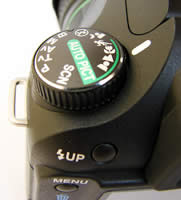 |
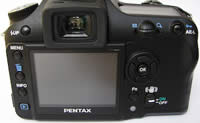
| Rear Controls | Mode Dial |
Pick the camera up, attach the supplied lens and this DSLR impresses from the off. Despite the budget pricing nothing about the K100D Super's build itself feels compromised, with the weight and heft transcending its entry-level status. It's just a tad larger than the D40 or E-410 from Olympus and in fact feels a more fully rounded and sturdier camera for it. That said Pentax's DSLR is still lightweight enough for you to carry around over your shoulder all day and not feel like you've been lugging bricks, even with the four bog standard alkaline AAs that power it inserted. Although at worst these lasted me only a day and a half of shooting � Pentax claims power is good for 80 captures though I managed more than double that � back up supplies can be easily found and replaced in whichever country you're in.
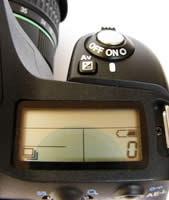
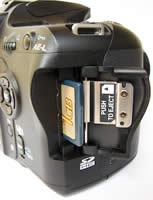
Keeping things user friendly, images are saved to SD card, again arguably the commonest media format currently available � a slot for which is accessed via the right hand side of the DSLR, if viewed from the back. The batteries are stored in a separate compartment at the base of the handgrip. Up top the main controls have been given room to breathe, meaning that they're uncluttered and feel ergonomically placed, readily falling under forefinger or thumb. Basically you feel as though you can pick the K100D Super up and get shooting straight away, with no fiddly or strange control positioning to hamper or slow down operation. Plus, unusually for an entry-level DSLR, there's also an LCD status display window provided in addition to the main LCD at the rear � just like you'd find on higher end models.
Also rare at this price level � and very welcome � is the Pentax K100D Super's 11-point auto focus system, which is quick to determine subject matter, though unusually busy scenes � in my case traipsing around a crowded Japanese temple on the tourist trail � can cause it confusion. The camera is however quick to get going. Flick the on/off switch that handily encircles the main shutter button and you're up and shooting in around a second, and with no noticeable shutter delay. This ensured it was rare that I missed a shot.
 |
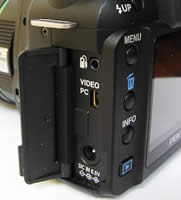 |
| Info LCD Panel | External Ports |
Next to the shutter release button is a dedicated button for aperture and exposure compensation adjustment (+/- 2EV), performed in tandem with the command dial that falls under your thumb at the back of the camera. Next to the dial is an AE-lock button that also doubles up as means of protecting images from accidental deletion when in playback mode. Next to the aforementioned status display window is a hump that houses the built-in pop up flash, and as expected you also get a hot shoe for additional illumination should it be desired. Just behind this, and above the optical viewfinder � which in itself is large and clear � is a large slider for diopter adjustment.
Lastly, and allowing DSLR novices to point and shoot from the off, there's a large, reassuringly chunky mode dial atop the Pentax K100D Super. Ranged around this are dedicated modes for moving subjects, close ups and night portraits � alongside the more creative likes of program, aperture priority, shutter priority, manual and, unusually, a bulb mode for subjects requiring a slow shutter speed, including fireworks and night scenes. These are backed up by full auto and scene mode settings. The latter includes a night scene setting � spot on for shots of Tokyo at night � a surf and snow setting, a text mode, sunset, kids, pet, candlelight and 'flash prohibited' museum modes. All are indicated via the rear screen by unthreatening cartoon icons.
As regards the rear LCD, visibility is good even in bright sunlight � more often than not the conditions I was using the Pentax K100D Super in � and, as you'd expect, the on screen menus are legible and easy to navigate. To the right of the screen is a four way control pad with central OK button � a similar set up to that found on most digital compacts that will be familiar to those trading up. A press of the function button � marked 'Fn' � located just below the four-way control pad brings up a virtual pad onscreen (since there are no outward markings). This affords quick access to changing drive mode, flash mode, white balance and ISO speeds, and it usefully avoids the need to waste time delving into sub folders.
 |
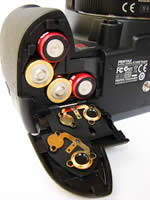 |
| Memory Card Slot | Battery Compartment |
Also below the four-way controller is that slider switch for activating shake reduction, which I tended to leave permanently switched on � a choice that provided fairly consistent results when shooting without flash. Like most systems, while not infallible you get a greater number of usable shots than could be achieved hand held without it. Switching over to the left hand side of the rear LCD we find an array of five buttons running down the left hand side. The top control is for manually activating the pop up flash, while below � and in order � are the familiar menu, deletion, info and playback buttons.
Press 'menu' and you've the choice of four brightly detailed folders � image record/capture mode and playback settings displayed next to each other so you can make decisions and adjustments on the fly. The third folder contains the familiar set up options, with the fourth affording access to custom settings if so wished. A press of that second-to-bottom 'info' button when in capture mode instantly displays all the current settings you have activated on one screen. Overall the K100D Super feels very responsive and any settings and changes are swiftly implemented. There's not a lot of fiddling around necessary with the Pentax K100D Super, which is to be commended.
So, how do things shake up when it comes to image quality? Read Page 2 to find out.
|
 PhotographyBLOG
is a member of the DIWA
organisation. Our test results for the Pentax K100D Super have been submitted to DIWA
for comparison with test results for different samples of
the same camera model supplied by other DIWA
member sites.
PhotographyBLOG
is a member of the DIWA
organisation. Our test results for the Pentax K100D Super have been submitted to DIWA
for comparison with test results for different samples of
the same camera model supplied by other DIWA
member sites.