
Ricoh Caplio GX
Review Date: July 19th 2004
|
Image Quality
All of the sample images in this Review were taken at the highest JPEG quality setting of F2592, which gives an average image size of around 1.7Mb - 2Mb.
Noise
There are 6 ISO settings available on the Caplio GX, which you can select at any time. There is also an Auto setting if you want to let the camera decide the best speed for the current situation. Here are some 100% crops which show the noise levels for each ISO setting:
ISO 64 (100% crop) |
ISO 100 (100% crop) |
 |
 |
ISO 200 (100% crop) |
ISO 400 (100% crop) |
 |
 |
ISO 800 (100% crop) |
ISO 1600 (100% crop) |
 |
 |
The noise levels look fine at ISO 64 and 100, but some noticeable noise is starting to appear at ISO 200, and ISO 400 and 800 are very noisy. ISO 1600 will only ever be useful in a dire emergency. You would probably want to avoid using any setting above ISO 100 unless you had no choice.
Sharpening
Here are two 100% crops which have been Saved as Web - Quality 40 in Photoshop. The right-hand image has had some sharpening applied in Photoshop. The images were shot with the Sharpness set to "Normal". Consequently they are fairly sharp straight out of the camera, but they do benefit from extra sharpening in Photoshop.
Original 100% Crop |
Sharpened 100% Crop |
 |
 |
 |
 |
File Quality
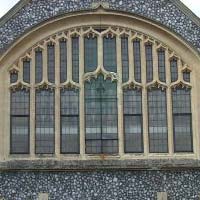
The Caplio GX has no less than 7 different JPEG quality settings and also a TIFF format. Here are some 100% crops which show the various file quality settings.
NC2592 (TIFF) |
F2592 |
 |
 |
N2592 |
F2048 |
 |
 |
N2048 |
F1280 |
 |
 |
N1280 |
N640 |
 |
 |
Chromatic Aberrations
The Ricoh Caplio GX suffers from quite excessive chromatic aberrations in bright outdoor conditions where there is high-contrast. There was no sun in the sky when I took the images shown below, but the sky itself was a stark shade of white. Both the tree branches and the sides of the buildings clearly show strong purple fringing.
 |
 |
 |
Overall Image Quality
The image quality of the Ricoh Caplio GX is quite disappointing. It's biggest achilles heel seems to be purple fringing, with more in evidence than other digital cameras that I've reviewed, even in photos where the sun is not in the frame. The images aren't particularly noisy at the lower ISO speeds of 64 and 100, but at faster speeds there is too much noise to be acceptable and I can't imagine ever using ISO 1600, or even ISO 400 and 800 for that matter. At the default sharpening setting of "Normal" the images are fairly sharp and won't require too much sharpening during post-processing. So overall not a great performance, which is doubly disappointing because the camera is such a joy to use.
|