
Sony A100 Review
Review Date: September 18th 2006
Author: Gavin Stoker
Leave a comment about this Review
|
Introduction
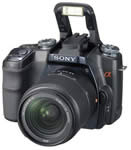
The Sony A100 is Sony's first foray into the digital SLR market. Born out of a collaboration with Konica Minolta (who have subsequently exited the camera business), the Sony A100 builds on the existing Maxxum/Dynax lens mount with the re-christened Alpha mount, with most Konica Minolta lenses being supported. The A100 also incorporates several other Konica Minolta technologies, most notably an anti-shake system that's built into the A100's body and the eye-start auto-focus system, which makes the camera continuously focus when you hold the viewfinder up to your eye. Sony haven't simply repackaged existing technologies, however; they've added their own to the A100, including an anti-dust system (as previously seen only on Olympus DSLRs), Dynamic Range Optimiser which corrects difficult exposures, and the new, rather strangely named Bionz Image Processor. Add to all this a 10 megapixel sensor, ISO range of 80-1600, unlimited continous shooting at 3fps in JPEG mode, 750 shot battery life and large 2.5 inch LCD screen, and you can see that the Sony A100 is an aggressive move against the likes of Canon and Nikon. It's all very well including a lot of impressive-sounding techologies into a camera, but have Sony actually come up with a DSLR that is user-friendly and produces good pictures? Read on to find out...
Compare Prices
Support PhotographyBLOG: Buy the Sony A100 from one of our affiliate retailers:Features
The Sony A100 has a 10.8 megapixel , 23.6 x 15.8 mm RGB CCD that delivers 10.2 effective megapixels. There are 3 image size settings (3872 x 2592 (L), 2896 x 1936 (M) and 1920 x 1280(S) and two levels of compression (Fine and Standard), which are recorded as JPEGs (8 bit). RAW (12 bit) format is also available, giving an image size of 3872 x 2592 pixels. An 18-70mm lens is supplied as part of the standard kit, which is equivalent to 27-105mm due to the 1.5x focal factor. The camera supports Compact Flash (Type I and II) and Memory Stick Duo / Pro Duo memory cards (via a supplied adaptor). The Sony A100 offers an Anti-dust protection system. The CCD sensor's anti-static coating acts as a barrier to dust, while a CCD vibration function briefly shakes the sensor to dislodge dust particles every time the A100 is powered off. The Super SteadyShot anti-shake system (in the camera body) compensates for camera vibrations at the instant the shutter is released by shifting the CCD sensor in real time for sharper, steadier pictures.
The Sony A100 offers four advanced exposure modes - Programmed AE [P] with flexible program; Shutter Priority Auto [S]; Aperture Priority Auto [A]; Manual [M] - and 6 different scene modes (Portrait, Landscape, Macro, Sports, Sunset, Night portrait), plus a fully automatic Auto mode. Exposure compensation can be set up to +-2 EV in increments of 1/3 EV, and there is auto-bracketing (3 frames, 0.3 or 0.7 EV steps). There is also an auto-exposure and auto-focus lock button. The Dynamic Range Optimiser automatically adjusts gamma curve and exposure levels for more natural, evenly-exposed pictures under difficult lighting conditions. The shutter speed range is 1/4000 - 30 sec with a Bulb option also available. There are 7 different ISO speeds ranging from 80 to 1600.
For focusing the Sony A100 uses a 9-point autofocus system with a central cross-hair sensor. There are 5 different focusing modes available - Single-shot AF, Direct Manual Focus, Continuous AF, Automatic AF and Manual focus - and 3 metering modes - Multi-Segment, Centre-weighted and Spot. The camera has 9 autofocus points which can be selected automatically or manually, and you can also choose from Wide AF area or Spot AF area (center). Focus can be locked by pressing the shutter-release button halfway (single-servo AF) or by pressing the AE-L/AF-L button. Depth of Field preview is available. An Auto-focus assist lamp is also available when the pop-up flash is raised. For White Balance, there is an Auto setting, six manual modes, manual white balance and the ability to set a specific colour temperature (2500-9900 Kelvin).
The Sony A100 offers single and continuous shooting modes with a maximum shooting speed of 3 fps for unlimited shots when using JPEGs. In RAW mode, the speed is 3fps for up to 6 shots. The camera also has a self-timer mode (2 seconds or 10 seconds) and 3 different bracketing modes (Continuous, Single-frame and White balance). There are 2 colour space choices, sRGB and Adobe RGB, and various colour modes can be selected (Standard, Vivid, Portrait, Landscape, Sunset, Night view, B&W). Contrast, Saturation and Sharpness can all be configured in-camera.
The built-in flash offers a range of different modes; Auto, Fill Flash, Red-eye Reduction, Wireless/Remote Off-camera Flash, Rear Flash Sync, High Speed Sync and Slow Sync with AE Lock. It has a guide number of 12, supports lenses as wide as 24mm and offers a Sync speed of up to 1/160 sec. The Sony A100 has a hotshoe that accepts Sony dedicated flashguns, either auto or manual. Flash compensation from -2.0 to +2.0 EV in 0.3 EV steps is available.
To compose your images you use the optical viewfinder monitor. The Sony A100 offers 95% scene coverage and 0.83x magnification. The viewfinder has built-in diopter adjustment, a Spherical Acute Matte screen, 20mm eye relief, and EyeStart Autofocus. To playback your images, the camera has a 2.5 inch LCD screen with 230,000 pixels and an anti-reflective coating. PictBridge support allows direct printing with compatible printers, and the DPOF and PRINT Image Matching III features allow you to configure options for printing your images.
The Sony A100's dimensions are 133 (W) � 71 (H) � 95 (D) mm (body only), and it weighs 545g, not including battery, lens and storage card fitted. The A100 is powered by a rechargeable Lithium-ion battery, which has an approximate CIPA battery life of 750 shots. There is a metal tripod mount in the centre of the bottom of the camera body.
Finally, the standard box kit contains a Lithium-Ion Battery, Battery Charger, Video Cable, USB Cable, Shoulder strap with eyepiece cap and Remote Commander clip, MS-Duo to CF Adaptor, Body cap, Accessory shoe cap, and a CD-ROM containing Image Data Converter SR Ver.1.1/Picture Motion Browser Ver.1.1. Note that there is no memory card supplied, as is the case with most DSLR cameras. You will therefore need to invest in some memory cards to store your images on.
|
 PhotographyBLOG
is a member of the DIWA
organisation. Our test results for the Sony A100 have been
submitted to DIWA
for comparison with test results for different samples of
the same camera model supplied by other DIWA
member sites.
PhotographyBLOG
is a member of the DIWA
organisation. Our test results for the Sony A100 have been
submitted to DIWA
for comparison with test results for different samples of
the same camera model supplied by other DIWA
member sites.